
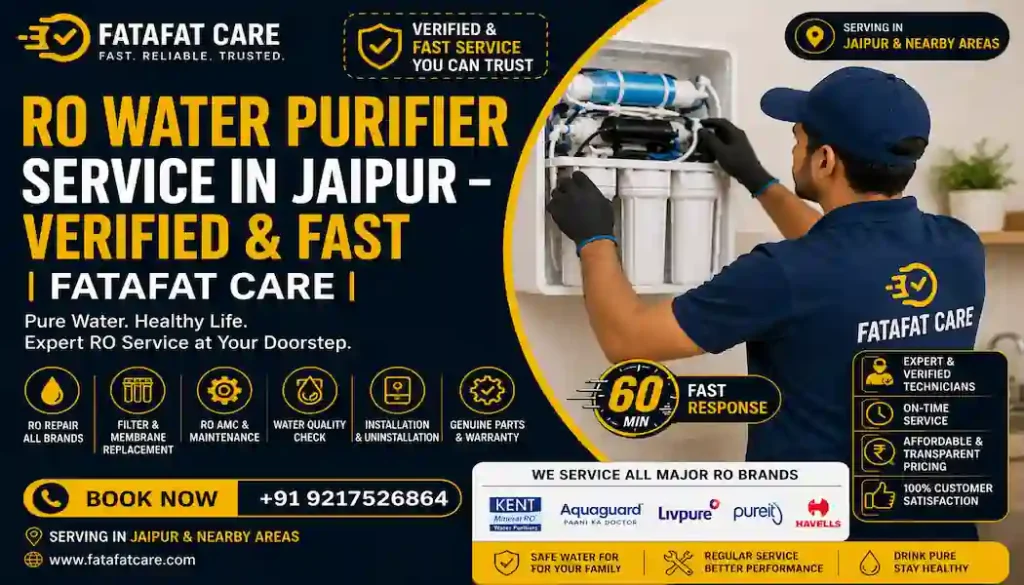
Most people in Jaipur don’t think about their RO purifier until the water starts tasting off or the output slows to a trickle. By that point the filters have been overdue for months — and in Jaipur’s water conditions, that delay usually means the problem has gone from a simple filter change to something more expensive.
This guide covers why Jaipur’s water is genuinely hard on RO systems, what the most common problems are, what you should pay for ro water purifier service in Jaipur, and how to keep your purifier running well instead of just reacting when it stops.
Why Jaipur’s Water Is Harder on RO Systems Than Most Cities
Spend a few months in Jaipur and the water makes itself known. Whitish deposits on taps, utensils that need extra scrubbing, geysers that need element replacement every few years — it all comes back to the same thing. The water here carries a heavy mineral load. TDS readings across most of the city fall between 400 and 900 ppm, and in places like Bassi, Sanganer, and Murlipura the number climbs even higher. Five hundred is roughly where drinking water stops being ideal — and plenty of Jaipur homes are already past that before the water even reaches the purifier.
What this means practically is that your RO membrane is working harder than it would in a city with softer water. The sediment and carbon pre-filters that protect the membrane clog faster. A filter that might usable up to 12 months in Delhi or Mumbai lasts 4 to 6 months in Jaipur before it’s restricting flow and letting sediment through to the membrane.
When those pre-filters aren’t changed within the prescribed time duration, the load shifts to the membrane. Membranes are far more expensive than filters. A ₹250 filter change ignored for six months can turn into a ₹900 membrane replacement — and if the membrane runs degraded long enough, the booster pump starts working harder to compensate and eventually burns out too. One ignored service visit becomes a ₹2,500 repair.
Fluoride levels in Jaipur’s water are also higher than average in several areas. This doesn’t affect RO performance directly but it’s one of the reasons RO systems are genuinely necessary here rather than optional — a regular filter jug won’t remove fluoride.
The Most Common RO Problems in Jaipur Homes
Slow water output — This is one of the most common problems. You turn the tap and wait. And wait. The tank that used to fill in an hour is now taking three, or barely producing anything at all. Nine times out of ten in Jaipur it’s the sediment filter — clogged with the kind of heavy mineral load the water carries here. But if a new filter doesn’t fix it, the membrane or pump is usually the next thing to check. Either way don’t sit on it. Slow output means something upstream is already being pushed harder than it should be.
Bad taste or smell — if water tastes flat, metallic, or has a smell even after purification. Usually means the post-carbon filter is exhausted or not working. This filter is responsible for final taste improvement and it’s the one most people skip because the water still looks clear without it.
TDS not reducing — you check the output with a TDS meter and it’s not much lower than the input. The membrane has degraded and is no longer filtering effectively. In Jaipur’s high-TDS water this happens faster than the manufacturer’s stated lifespan, especially if pre-filters weren’t changed regularly.
Water leaking from the unit — RO has the problem of dripping from a pipe fitting, the tank connection, or the filter housing. Most leaks are at push-fit connectors that have loosened over time. Small leaks ignored for weeks cause water damage to the cabinet below and sometimes the wall.
RO not switching on — the unit is completely dead. Usually it happens because of a power supply issue, a tripped ELCB, or sometimes the booster pump motor gets burnt. In Jaipur, pump problems are more common during summer because voltage fluctuations put extra pressure on the motor.
UV lamp not working — no indicator light on the UV stage or the lamp has exceeded its service life. UV lamps need annual replacement regardless of whether they appear to be working — the germicidal effectiveness drops well before the lamp visibly fails.
RO Service Costs in Jaipur — 2026 Realistic Pricing
Pricing for RO water purifier service in Jaipur varies a lot depending on who you call and what brand your purifier is. Here’s what’s realistic:
| Service | Starting Price |
|---|---|
| Inspection and TDS check | ₹199 onwards |
| Sediment filter replacement | ₹199 onwards |
| Carbon filter replacement | ₹249 onwards |
| Post-carbon filter replacement | ₹249 onwards |
| RO membrane replacement | ₹799 onwards |
| UV lamp replacement | ₹399 onwards |
| Booster pump repair | ₹499 onwards |
| Leakage repair | ₹249 onwards |
| Full service — all filters | ₹699 onwards |
| New RO installation | ₹499 onwards |
Prices are for labour and standard filters. Brand-specific or high-capacity membranes cost more. Fatafat Care technicians share a full estimate after checking your unit — you approve before any work starts.
How Often Should You Service Your RO in Jaipur
The standard manufacturer recommendation is annual servicing. In Jaipur that’s not enough.
Sediment and carbon pre-filters — every 4 to 6 months. If your area has particularly high sediment in the supply water, closer to 4. You’ll know it’s time when output starts slowing noticeably.
RO membrane — every 18 to 24 months in high-TDS areas like Jaipur. Check with a TDS meter: measure input water and output water. If the rejection rate has dropped below 75% — meaning output TDS is more than 25% of input — the membrane needs replacing.
UV lamp — annually, regardless of whether it appears to be working. The germicidal effectiveness of a UV lamp drops significantly after 8,000 to 9,000 hours of use even if the light is still on.
Post-carbon filter — every 12 months. This is the one that makes water taste clean. It’s cheap to replace and makes a noticeable difference.
Full system check — once a year. Have a technician check all connections for micro-leaks, test water pressure, check the tank bladder pressure, and verify TDS before and after each filter stage. Catching a failing component early costs a fraction of replacing it after it’s caused secondary damage.
How to Check Your RO Is Actually Working
A TDS meter costs under ₹400 at any electronics shop or online. Every Jaipur household with an RO should own one. Here’s the things to know how to use it:
Fill a glass with tap water and measure TDS. Note the number. Fill a glass with RO output water and measure. Simple math — whatever your tap water reads, your purifier output should be roughly a quarter of that or less. Input of 600 ppm means you want to see 150 or below coming out. Anything higher than that and the membrane has lost its effectiveness.
Also you always check output flow by timing how long it takes to fill a 500ml glass. A properly working RO fills a 500ml glass in under a minute. If you’re standing there for two or three minutes waiting, something is restricted or the pump is losing power — either way it needs attention.
Do these two checks every 3 months. It takes 5 minutes and tells you exactly when service is due rather than waiting for something to fail completely.
Areas in Jaipur Where Fatafat Care Provides RO Water Purifier Service
We cover most of Jaipur for RO water purifier service — Bassi, Mansarovar, Vaishali Nagar, Malviya Nagar, Jagatpura, Sanganer, Sitapura, Amer, Jhotwara, Murlipura, Shastri Nagar, Raja Park, Bani Park, and the villages around them. If your area isn’t on this list, just WhatsApp us — chances are we cover it or have someone nearby.
Not sure if your area is covered? WhatsApp us and we’ll confirm within minutes.
Booking RO Water Purifier Service Through Fatafat Care
WhatsApp 9217526864 with your RO problem and location. We confirm a slot — same day in most cases. Technician arrives within 60 minutes, checks TDS and water pressure, shares a full estimate for expenditure, and starts only after you approve. No advance payment.
Frequently Asked Questions – RO Water Purifier Service in Jaipur
How often should RO filters be changed in Jaipur?
Sediment and carbon filters every 4 to 6 months due to Jaipur’s high TDS water. Membrane every 18 to 24 months. UV lamp annually. Post-carbon filter annually. More frequent than manufacturer recommendations because Jaipur’s water works harder on every component.
Why is my RO output so slow in Jaipur?
Almost always it’s the sediment filter — Jaipur’s water carries enough mineral load that it chokes pre-filters well before the replacement date on the box. Swap that first. If the flow is still slow after a fresh filter, then the membrane or booster pump is where to look next.
How do I know if my RO membrane needs replacing?
Get a TDS meter — they cost under ₹400 and every Jaipur home with an RO should have one. Check your tap water TDS, then check the purifier output. If the output reading is more than 25% of the input, the membrane has stopped doing its job properly. Time to replace it.
Which RO brands do you service in Jaipur?
Kent, Aquaguard, Pureit, Livpure, AO Smith, Blue Star, Havells, Whirlpool — and honestly whatever else is out there. If it’s being sold in Jaipur, our technicians have seen it.
Is same-day RO service available in Jaipur?
Yes. For most Jaipur areas we connect you with a technician within 60 minutes. Available 7 days a week including Sundays from 8am to 9pm.
Can you install a new RO purifier at my home in Jaipur?
Yes — new installation with wall mounting, pipe fitting, and a TDS check after installation to confirm the system is working correctly.
Pingback: Home Maintenance Services in Rajasthan — Complete Guide 2026 | Fatafat Care