
AC Not Cooling? 10 Reasons and How to Fix It
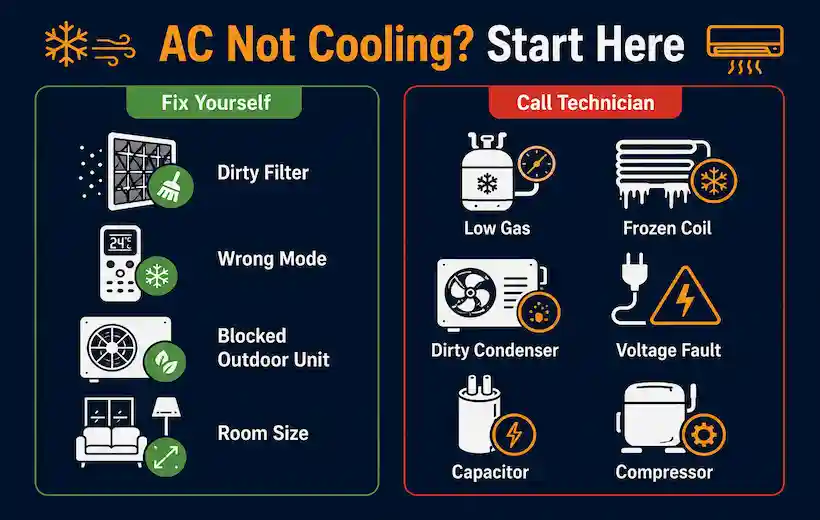
Your AC is running, the light is on, the fan is blowing — but the room just will not cool. We have diagnosed this problem hundreds of times. Four of the ten AC not cooling reasons on this list you can fix yourself in under 15 minutes. The other six need a technician, and knowing which is which saves you time, money, and unnecessary panic at 2 am in May. This guide covers all 10 AC not cooling reasons clearly — starting with the simplest checks and moving to the more serious faults
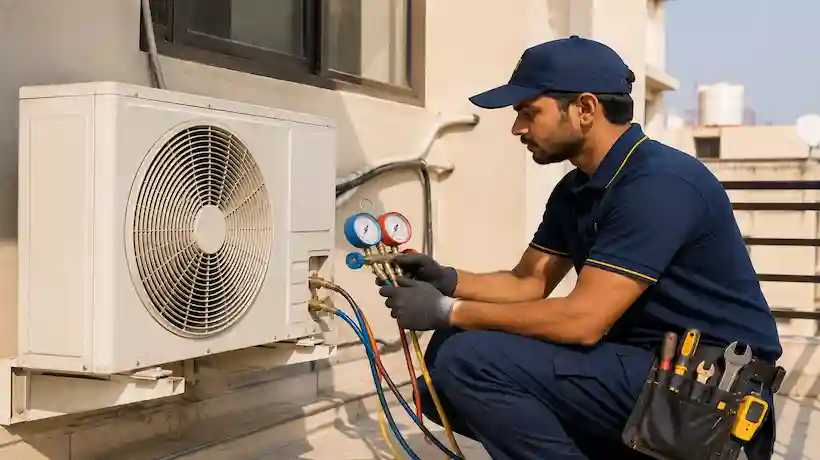
In peak Indian summer — temperatures crossing 44°C to 48°C across large parts of the country — a split AC that stops cooling is not just uncomfortable. It is a health risk for children, elders, and anyone who has to sleep in that room. And what makes it worse is that in most cases, the fix was simple. It just needed the right diagnosis.
We work with ACs every day — Voltas, LG, Daikin, Samsung, Blue Star, Hitachi, Panasonic, O General, Carrier. Across all brands, the AC not cooling reasons follow the same pattern. Some are user-fixable checks that take 10 minutes. Others are faults that need proper tools and a trained hand. This guide gives you the full picture honestly — no vague advice, no unnecessary panic.
Read through from the top. The reasons are arranged from the simplest and most common down to the more serious. Start checking from Reason 1 before assuming the worst.
All 10 AC Not Cooling Reasons at a Glance
Understanding the AC not cooling reasons before calling anyone saves you time and an unnecessary service charge.
Detailed Breakdown — Every AC Not Cooling Reasons Explained
Dirty or Clogged Air Filter
Fix YourselfThis is the single most common AC not cooling reason across every brand we service — and the most avoidable. The filter is just a mesh panel sitting inside the indoor unit — its job is to catch whatever is floating in your room air before it reaches the coil inside. In India, particularly in dusty environments, filters choke up in 2 to 3 weeks during heavy summer use.
When a filter is blocked, airflow across the evaporator coil drops sharply. The coil cannot absorb heat from the room. The AC runs at full power but the room temperature barely moves. Electricity consumption goes up while cooling goes down — the worst possible combination.
There is another consequence that most people do not know: a severely blocked filter causes the evaporator coil to freeze (see Reason 6). What started as a simple filter issue becomes a frozen coil that needs a technician visit. All of this is preventable.
Fix it yourself: Open the front panel of your indoor unit — it usually swings up or unclips without tools. Slide out the filter. It is that mesh panel, usually grey or white. If it is dark grey, brown, or matted with dust — rinse it under a tap. Let it dry completely in shade for at least 30 minutes. Never put a wet filter back in. Slide it in, close the panel, and restart the AC. This single step restores 15 to 25% cooling efficiency in most cases.
How often: Every 2 to 3 weeks during summer. Once a month during cooler months. In particularly dusty locations, once a week is not excessive.
Wrong Mode or Thermostat Setting
Fix YourselfThis gets more calls than people expect. The AC remote has multiple modes — Cool, Fan Only, Dry, Auto, and sometimes Heat on newer inverter models. If someone pressed the wrong button, the unit will run — the fan will blow — but no cooling happens because the compressor is not engaged.
Fan Only mode catches more people than you would think. The indoor unit blows hard, the vents are pushing air, everything looks like it is working — but the outdoor unit is dead silent. No compressor running, no cooling happening. The room stays exactly as hot as it was. We have had customers call us convinced their compressor had failed, and the fix was pressing the Mode button once — the simplest AC not cooling reasons there are.
Fix it yourself: Hit Mode on the remote till you see the snowflake. Then look at the temperature — if the room is 30°C and you’ve set 28°C, the compressor has almost nothing to work with. Push it down to 20°C or 22°C. Give it 15 minutes. Nine times out of ten, that’s the whole problem.
Also check the remote batteries. A weak battery can send partial signals, causing the AC to enter the wrong mode without you realising it.
Blocked or Dirty Outdoor Unit
Fix YourselfThe outdoor unit is where your AC throws the heat it pulls from your room. If that heat has nowhere to go — walls too close, stuff stacked around it, fins choked with dust — the whole system just stops cooling properly. A blocked outdoor unit is one of the most overlooked AC not cooling reasons we come across.
In ground-floor homes we regularly find the outdoor unit buried behind gas cylinders, old buckets, or whatever else got dumped in that corner over the years. In first-floor installations, dust and cottonwood (poplar seeds in spring) can mat the condenser fins solid. In both cases, the AC compressor works harder, draws more current, and delivers less cooling — exactly the opposite of what you want.
Fix it yourself: Walk outside and look at the unit. There should be at least 30 cm of clear space on all sides, and ideally 1 metre of clearance on the outlet side (where the fan blows). Remove any stored items. Use a dry soft brush to clean the fins from outside. If the fins are caked, a light spray with a garden hose (low pressure, not jet mode) clears them effectively. Do not use a pressure washer — it bends the fins. After clearing, restart the AC and compare the cooling.
Undersized AC for the Room
Fix YourselfThis is not a fault — it is a mismatch. A 1-ton AC is designed for a room of roughly 100 to 120 square feet with standard ceilings and reasonable insulation. A 1.5-ton handles 150 to 180 square feet. But these numbers assume average conditions. In India, several things push heat load higher than the rule of thumb accounts for.
South or west-facing rooms with large glass windows absorb significant solar heat in the afternoon. Rooms with RCC rooftops on upper floors get conducted heat from the slab throughout the day. Older homes with lime plaster walls and no roof insulation gain heat faster than modern construction. A 1.5-ton AC in a 160 sq ft room with a west-facing glass wall and an exposed RCC roof may genuinely struggle between 2 pm and 6 pm in May — even if the AC itself is perfectly healthy.
What helps without replacing the AC: Before assuming something is broken, try the cheap fixes first. Heavy curtains on the west or south-facing windows make a real difference — afternoon sun through glass dumps heat directly into the room the AC is trying to cool. Close the gaps under doors so cold air isn’t bleeding out constantly. Switch off the TV, laptop, and anything else generating heat near the unit. Run a ceiling fan alongside the AC — a 25°C room with moving air genuinely feels like 22°C. Do all of this before calling anyone.
Low Refrigerant Gas (Gas Leak)
Call TechnicianRefrigerant gas is what actually moves heat. The compressor pushes refrigerant around a closed loop — it picks up heat from your room at the indoor coil, carries it outside, dumps it there, and comes back for more. When gas leaks anywhere in that loop, the system can’t carry enough heat out. The AC runs fine on paper but the room stays warm. Low refrigerant is among the more serious AC not cooling reasons because it never fixes itself.
Here is something important that technicians often do not explain clearly: refrigerant in a properly working AC never runs low. It is a sealed system. If your AC is low on gas, there is a leak — from a loose flare fitting, a pinhole in the copper pipe, a damaged valve, or a manufacturing defect. Topping up the gas without finding and fixing the leak is like filling a punctured tyre with air. It will be low again in 4 to 8 weeks.
What a proper repair looks like: The technician connects gauges to check the system pressure. If low, they use a leak detector or soap solution to find the exact source. The leak is sealed first — then the system is vacuumed to remove air and moisture, then recharged to the correct pressure for your specific model and refrigerant type (R22, R32, or R410A). Any technician who skips the leak detection step and just adds gas is cutting corners at your expense.
Approximate cost: ₹1,200 to ₹2,800 depending on refrigerant type, quantity needed, and leak repair complexity.
Frozen Evaporator Coil
Call TechnicianMost people don’t believe this until they see it. In 46°C heat outside, the coil inside your indoor unit can literally freeze solid. It happens when airflow drops too low — the coil surface goes below zero and ice builds up on it. Once that happens, it can’t absorb heat from the room anymore. The AC runs at full power and blows air that feels like nothing.
The irony: the two most common causes of a frozen coil are a clogged filter (Reason 1) and low refrigerant gas (Reason 5). So this is often a downstream consequence of something that started simple and was left unattended.
What to do immediately: Switch the AC off at the remote. Switch it to Fan Only mode and let it run for 20 to 30 minutes — this melts the ice without the compressor running. Do not turn the cooling back on until all ice has melted. Then clean the filter. If the coil freezes again the following day, the root cause has not been fixed and you need a technician to check the refrigerant and do a full coil inspection.
Critical warning: Running an AC with a frozen coil for extended periods forces the compressor to work against abnormal pressure. This converts a ₹500 coil cleaning into a potential ₹15,000 compressor replacement. Switch it off the moment you suspect freezing.
Dirty Condenser Coil in Outdoor Unit
Call TechnicianEven when the outdoor unit looks presentable from the outside, the internal condenser coils — the dense metal fins through which the fan pushes air — can be coated with years of compressed dust, oil residue, and grime. When the coils are caked up, the outdoor unit can’t throw the heat out properly. The refrigerant goes back into the compressor still carrying heat it was supposed to dump outside. This AC not cooling reasons makes cooling quietly get worse over months — most people only notice when they think back and realise last summer wasn’t this bad.
This is a gradual problem, which is why people often miss it. They assume the AC is just aging when in reality a proper coil wash restores performance close to new.
A technician uses a chemical coil cleaner or a pressure washer at controlled pressure to wash the condenser fins from inside out. This is one of the core tasks in an annual AC service and the primary reason we recommend getting the full service done in February or March before summer starts — not in June when a waiting list is already forming.
Approximate cost: ₹500 to ₹900 for a condenser wash included in a full service. Standalone condenser wash ₹300 to ₹600.
Voltage Fluctuation or Electrical Fault
Call TechnicianThis is a particularly Indian problem. ACs are designed to operate at 220V to 240V. In many residential areas — especially older colonies, semi-urban localities, and areas with overloaded distribution transformers — voltage can drop to 160V to 180V during peak summer hours when the grid is under maximum load. At these voltages, the compressor struggles to start, runs at reduced capacity, or cuts out entirely through its internal protection relay.
Data from the Central Electricity Authority shows that monsoon months see 2.3 times the voltage anomaly incidence compared to dry months, making electrical issues a bigger factor in July and August than people realise.
Inverter ACs have another problem with bad power — the PCB and the variable-frequency drive inside are sensitive components. One bad surge and the board can get damaged even if the unit seems to survive it. You won’t always know immediately. The fault shows up days later when the AC stops cooling properly for no obvious reason
What helps: A properly rated voltage stabiliser — 5 KVA for 1.5-ton AC, 8 KVA for 2-ton — protects the compressor and PCB from both undervoltage and overvoltage. Most new inverter ACs handle 160V to 264V on their own. Older units and non-inverter models don’t — they need a stabiliser. Also worth getting an electrician to check the dedicated circuit while they’re there — wrong wire gauge or a mismatched MCB rating causes more problems than people realise.
Approximate repair cost: ₹400 to ₹1,500 for electrical connection work. Voltage stabiliser: ₹2,500 to ₹5,000 depending on capacity.
Faulty Capacitor
Call TechnicianThe start and run capacitors are small cylindrical components that give the compressor motor and the outdoor fan motor the initial burst of energy needed to start, and the sustained power to keep running efficiently. When a capacitor weakens or fails — which happens more often after voltage spikes, or simply with age in non-inverter ACs — the motor it serves cannot start properly or runs at reduced efficiency.
A failed capacitor is a common AC not cooling reason — and one of the cheaper ones to fix: the outdoor unit tries to start, makes a clicking or humming sound, and then shuts off without the compressor fully engaging. The indoor unit continues to run normally, blowing air — but without the compressor, there is no refrigerant movement and no cooling. Some ACs will keep trying and keep failing repeatedly. Others lock out and show an error code.
Capacitor replacement is a straightforward job for a trained technician — it typically takes 20 to 30 minutes. The part costs between ₹150 and ₹400 and labour is minimal. Total repair cost is usually ₹500 to ₹1,200. It is one of the cheaper AC not cooling repairs and worth diagnosing early rather than assuming a compressor fault.
Compressor Fault or PCB Failure
Call TechnicianCompressor fault is the most serious AC not cooling reason — and the most expensive. It pressurises the refrigerant and drives the entire cooling cycle. When the compressor fails — whether through winding failure, seized bearings, or a mechanical fault — the AC simply cannot cool at all. No amount of filter cleaning or gas refilling will help because without the compressor operating, refrigerant does not circulate.
On inverter ACs, the PCB (Printed Circuit Board) controls the compressor’s variable-speed drive. A PCB failure can either prevent the compressor from starting entirely, or cause it to run erratically — resulting in poor or inconsistent cooling. PCB faults are more common after sustained voltage spikes, monsoon humidity getting into the outdoor unit, or simply age on units over 8 to 10 years old.
Repair vs Replace — the honest calculation: Compressor replacement is expensive: ₹6,000 to ₹20,000 for the part alone, plus labour. PCB replacement: ₹2,500 to ₹8,000 depending on brand and model. Before agreeing to either repair on an older unit, ask your technician for the AC’s age and whether the repair cost exceeds 50% of a new AC’s price. On a unit over 8 years old, with a non-inverter compressor, replacing the entire AC with a 5-star inverter model often makes more financial sense — you recover the cost in electricity savings within 2 to 3 years.
Our technicians always give you this calculation honestly before recommending a repair. We do not have an incentive to oversell expensive repairs on dying units.
AC Not Cooling — Repair Cost Reference 2026
These are honest starting prices. Final cost depends on your AC brand, model, age, which parts need replacing, and the extent of the fault. We share the exact cost with you before starting any work. These costs correspond to the most common AC not cooling reasons diagnosed by our technicians.
| Problem | DIY or Technician | Approx Cost | Time to Fix |
|---|---|---|---|
| Dirty filter | DIY | Free | 10 minutes |
| Wrong mode / thermostat | DIY | Free | 2 minutes |
| Blocked outdoor unit (clearing) | DIY | Free | 15 minutes |
| Undersized AC for room | DIY | Free (management steps) | Immediate |
| Low refrigerant gas (leak + refill) | Technician | ₹1,200 – ₹2,800 | 1 – 2 hours |
| Frozen evaporator coil + root fix | Technician | ₹500 – ₹1,800 | 1 – 3 hours |
| Dirty condenser coil wash | Technician | ₹300 – ₹900 | 45 minutes |
| Voltage / electrical fault | Technician | ₹400 – ₹1,500 | 1 hour |
| Faulty capacitor replacement | Technician | ₹500 – ₹1,200 | 20 – 30 min |
| PCB repair or replacement | Technician | ₹2,500 – ₹8,000 | 1 – 3 hours |
| Compressor replacement | Technician | ₹6,000 – ₹20,000+ | Half day |
AC Still Not Cooling After Checking the Basics?
Book a Fatafat Care technician. Diagnosis done on-site. Price confirmed before work starts. No advance payment.
What Our Technician Checks on an AC Not Cooling Visit
When a Fatafat Care technician arrives at your home for an AC not cooling complaint, this is the exact sequence they follow. We are sharing this so you know what a proper diagnosis looks like — and can identify if someone is cutting corners.
Pulled out and checked immediately. If clogged, cleaned on the spot. This rules out the most common AC not cooling reasons in under 5 minutes.
Mode confirmed as Cool. Temperature setting verified. Indoor unit display checked for any error codes or warning indicators.
Fan speed checked visually and by sound. Condenser fins inspected for blockage. Clearance around the unit verified. Unit temperature assessed by hand — excessive heat indicates heat rejection problems.
Gauges get connected to the service ports on the outdoor unit. High-side and low-side pressures both get checked against what they should be for your specific refrigerant — R22, R32, or R410A — at the current outside temperature. If the numbers are low, there’s a gas leak somewhere in the system.
Indoor unit front panel removed. Coil checked for ice, frost, or visible dirt accumulation. Supply and return air temperatures measured — the difference between them indicates how much cooling is actually happening.
Capacitor checked with a multimeter for correct microfarad rating. Voltage at the outdoor unit measured. All wire connections checked for looseness or corrosion. MCB rating verified against AC’s stated current draw.
A clamp meter measures the actual current the compressor draws when running. High current = working too hard against a problem. Zero current = not running. Normal but no cooling = refrigerant issue confirmed.
After this sequence, we give you a clear diagnosis and cost estimate. No work starts until you approve. That is our standard process and it does not change regardless of how big or small the job is.
How to Prevent AC Not Cooling Problems — Annual Routine That Works
The majority of AC not cooling reasons that turn into expensive repairs in May could have been caught in February. Here is the simple annual routine that keeps an AC running well for 10 to 12 years.
- February or March — full annual service: Book a professional service before the summer rush begins. A complete service includes indoor coil cleaning, condenser coil wash, refrigerant pressure check, drain pipe flush, capacitor reading, and electrical connection inspection. This one service, done once a year, prevents the majority of summer breakdowns. Cost: ₹400 to ₹700 for most split ACs.
- Every 2 to 3 weeks during summer — filter cleaning: Remove the filter, rinse under a tap, dry in shade, refit. Takes 10 minutes. The single highest-return maintenance task you can do yourself.
- Monthly — outdoor unit check: Walk to the outdoor unit. Confirm clearance is maintained. Remove any leaves or debris from the fins. Takes 5 minutes.
- Immediately if performance drops: Do not wait weeks before acting. A gas leak caught early costs ₹1,500. A compressor damaged by running on low gas costs ₹15,000. The gap between these outcomes is usually just time.
- After extended power cuts or surges: Wait 3 to 5 minutes before restarting the AC. The system’s high and low side pressures need to equalise before the compressor starts cleanly. Restarting immediately after a power cut puts mechanical stress on the compressor.
Why People Book Fatafat Care for AC Repair
Areas We Cover for AC Repair
We provide verified AC repair and home repair services across Rajasthan and Gujarat. The areas below are where our technicians are currently active.
Jaipur, Rajasthan
Rajasthan Districts
Kachchh District, Gujarat
Ahmedabad, Gujarat
Surat, Gujarat
Book AC Repair — 60 Min Response
Verified technician. Cost shared before work. No advance payment required. Whatever the AC not cooling reasons turns out to be, we diagnose it on-site before any work starts. Call or WhatsApp directly.
Frequently Asked Questions — AC Not Cooling Reasons
Zero cooling usually means one of four things — wrong mode, filter so blocked the coil has frozen, gas gone from a leak, or the compressor not running at all. Check the remote first. If it shows a fan icon instead of a snowflake, that’s your answer right there — switch it to Cool and you’re done. Filter fine, mode fine, outdoor unit silent? That’s a gas or compressor issue and you need a technician.
In dusty areas — which includes most of Rajasthan and large parts of Gujarat — clean the filter every 2 to 3 weeks during summer heavy use. In cleaner environments or winter months, once every 4 weeks is enough. The filter slides out without tools, rinses under a tap in 2 minutes, and needs 30 minutes to dry before refitting. Never put a wet filter back in — moisture inside the indoor unit encourages mould growth. This single maintenance step prevents more AC not cooling problems than any other single action.
Three things cause this pattern. First, afternoon outdoor temperatures peak at 44°C to 48°C in summer, which means the AC has to work much harder to reject heat through the outdoor unit — if the condenser is dirty or clearance is poor, this is when the system fails. Second, if the evaporator coil is marginally frozen, it typically freezes up over several hours of continuous running — starting fine in the morning, failing by 2 pm. Third, voltage in many residential areas drops significantly in peak afternoon hours when grid load is highest, reducing compressor efficiency. Check the outdoor unit clearance and clean the filter first. If the problem continues, a technician needs to check gas pressure and compressor current draw under afternoon load conditions.
It depends on the cause. Running with a dirty filter is not dangerous but it wastes electricity and risks freezing the coil. Running with a frozen coil risks compressor damage — switch to Fan Only until the ice melts. Running with low refrigerant puts the compressor under mechanical stress and should be avoided for extended periods. Running with a voltage fault risks PCB and compressor damage. In short: if the AC is running but clearly not cooling, identify the cause before leaving it running for hours. An AC consuming full electricity with zero cooling is costing you money and potentially compressing the remaining life of expensive components.
A proper refrigerant recharge for an AC not cooling due to low gas should include: leak detection using an electronic detector or soap solution to find and fix the source of the leak, vacuuming the system to remove air and moisture before charging, and then charging the system to the correct pressure specified for your model and refrigerant type. If a technician arrives, connects a cylinder directly without checking for the leak, adds gas in 10 minutes, and leaves — that is not a proper job. The gas will leak out again within 4 to 8 weeks. Always ask the technician to confirm the leak source and how it was sealed before agreeing to a recharge.
Error codes on inverter ACs point to specific faults. Common ones: LG CH05 = communication fault between indoor and outdoor unit (often clears after a full power cycle at the MCB); Daikin F3 = compressor discharge temperature too high, usually low gas or a blocked condenser; Voltas and Blue Star share similar code structures for refrigerant and pressure faults. The first thing to try with any error code is a hard reset — switch off the MCB for 5 minutes, then restore power. This clears 30 to 40% of temporary fault codes. If the code returns immediately, you need a technician with a proper diagnostic tool to read the fault log and identify the component fault. Do not ignore recurring error codes — they indicate a real problem that worsens over time.