
MCB Keeps Tripping? 7 Causes and When to Call an Electrician
The MCB keeps tripping and you keep resetting it. Sometimes it holds, sometimes it trips again the moment a specific appliance turns on. This is your home’s electrical system telling you something — and the message matters. This guide covers every reason MCB keeps tripping, what you can safely check yourself, and which situations need a licensed electrician on-site immediately.
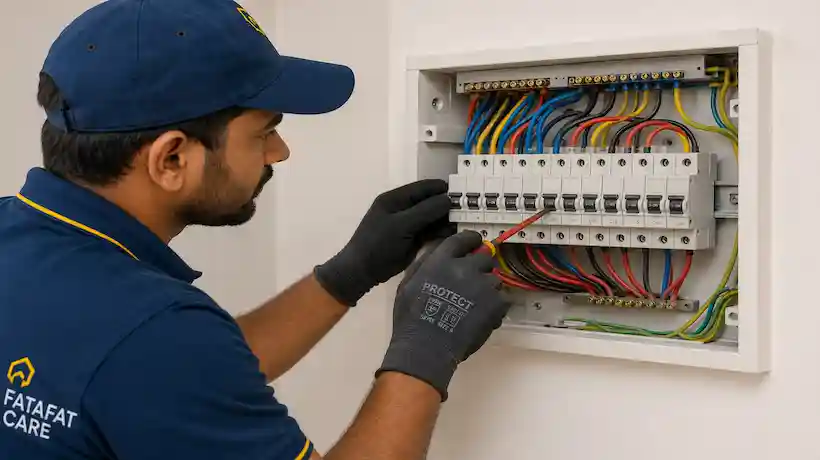
An MCB — Miniature Circuit Breaker — is not a nuisance. It is not a nuisance device. When the MCB keeps tripping, it is doing its job — cutting power before a wire burns or, in the worst case, before a fire starts. The problem is not the MCB. The problem is whatever is causing it to trip.
We deal with tripping MCB complaints regularly across Jaipur, Dausa, Gandhidham, Ahmedabad, and Kachchh — in homes old and new, in flats and independent houses, in summer and monsoon. Across all of those calls, the same 7 causes come up again and again. Two of them you can diagnose yourself in 10 minutes. The other five need a qualified electrician with proper tools.
Read this before resetting the MCB again. Repeated resetting without finding the cause can damage appliances, degrade wiring insulation, and in serious cases create a fire hazard. The MCB keeps tripping for a reason — find it first.
What Does an MCB Actually Do?
An MCB is a switch that cuts power automatically — the moment it sees too much current on a circuit or a sudden surge from a fault, it trips. That is it. You never think about it until the lights go out and you are standing in the dark looking for the switchboard.
Most Indian homes have a distribution board with multiple MCBs — one main MCB and several smaller ones for individual circuits: lights, fans, AC, geyser, kitchen appliances, and so on. When one MCB trips, only the devices on that circuit lose power. When the main MCB trips, everything goes.
The pattern of when and how the MCB trips is the biggest clue to what is causing it. Note these things before calling anyone:
- Does it trip immediately when reset, or after a few minutes of running?
- Does it trip only when a specific appliance is switched on?
- Does it trip more in the afternoon or during monsoon?
- Is it the main MCB or an individual circuit MCB?
- Is there a burning smell, scorch mark, or any sound from the distribution board?
These answers narrow down which of the 7 MCB keeps tripping causes applies to your situation.
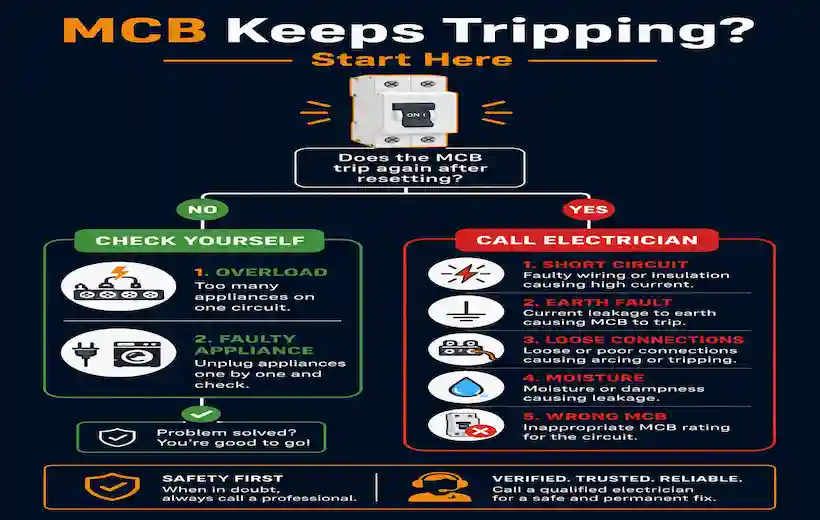
All 7 MCB Keeps Tripping Causes at a Glance
Detailed Explanation — Every MCB Keeps Tripping Cause
Circuit Overload — Too Many Appliances on One Circuit
Check YourselfThis is the most common reason MCB keeps tripping in Indian homes — and the simplest to understand. Every MCB has a current rating, typically 6A, 10A, 16A, or 32A for residential circuits. A 16A MCB will trip when the total load crosses roughly 3,680 watts — that is 16 amps multiplied by 230 volts. Cross that number and it cuts power, no warning.
In summer, this becomes a daily reality. The AC is on, someone switches on the geyser to bathe, someone else plugs in the iron, and the microwave starts in the kitchen — all drawing from the same circuit or through the same main MCB. The load adds up fast. The MCB trips not because anything is broken, but because the total wattage simply exceeds what the circuit was designed to carry.
What to check yourself: Cast your mind back to the exact moment it tripped — what was on? Geyser running, AC on, someone using the iron, microwave going. Add those up and you’re easily past 5,000 watts on one line. The MCB tripped because it had to. That’s not a fault — that’s just too much load.
Long-term fix: High-load appliances — AC, geyser, washing machine — should each have a dedicated circuit with its own MCB. If your home does not have this setup, an electrician can add dedicated circuits. This is a one-time job that prevents the MCB keeps tripping problem permanently on overload circuits.
Faulty Appliance — The Problem Is What You Plugged In
Check YourselfThis is the MCB keeps tripping cause that most people overlook because the appliance often still looks like it is working. Something inside the appliance has gone bad — a heating element, a motor winding, a capacitor. Whatever it is, the appliance now pulls more current than it should every time it switches on. The MCB sees that and trips.
Common culprits in Indian homes: Old geysers, irons with frayed cords, motor pumps, fridges with a failing compressor — these are what we find most often. Damaged extension boards too, which people never suspect because they look fine from outside. An extension board with a broken internal connection is particularly deceptive — it looks fine from outside but causes a dead short the moment something is plugged into the damaged socket.
How to identify the faulty appliance: Unplug every device on the circuit. Reset the MCB. If it holds with nothing plugged in, the wiring is fine — the fault is in one of the appliances. Now plug them back in one by one, waiting 1 to 2 minutes between each. When the MCB trips after plugging in a specific appliance, that is your answer. Stop using that appliance and get it repaired or replaced before using that circuit again.
If the MCB trips instantly even with nothing plugged in, the fault is in the wiring itself — not an appliance. Stop here and call an electrician. That is short circuit territory.
Short Circuit — Live and Neutral Wires Touching
Electrician — UrgentA short circuit is what happens when the live wire and neutral wire make direct contact — either inside a wall, inside a socket, inside an appliance, or at a connection point. The current takes a shortcut through near-zero resistance and surges to an enormous level in milliseconds. The MCB reacts almost instantly and trips. This is exactly what it is designed to do — without it, the wiring would overheat and start a fire.
Short circuits in home wiring happen from a few specific causes: damaged insulation on wires inside the wall (common in homes over 15 to 20 years old, or where rodents have chewed wiring), a loose wire that has slipped out of its terminal and touched another conductor, water getting into a junction box or socket, or poor-quality electrical work where wires were not properly insulated at joins.
What to do: Do not keep resetting. If the MCB trips instantly every time, there is an active short circuit in the wiring. Switch off the main supply at the meter if possible. Call an electrician. A short circuit in the walls is not visible and cannot be fixed by guesswork — it requires an insulation resistance test with a megohmmeter to locate the fault.
This is one of the MCB keeps tripping causes where delay genuinely increases the risk of fire. The wiring insulation degrades further every time a short circuit occurs, and repeated short circuits in the same location can eventually cause ignition of surrounding material.
Earth Fault — Current Leaking to Ground
Electrician — UrgentAn earth fault happens when live current escapes from the circuit it is supposed to stay in and finds a path to ground — through a damaged appliance casing, through deteriorated wire insulation, through a wet surface, or through a person who touches a faulty appliance. The MCB may or may not trip depending on the magnitude of leakage current. If it does trip, the MCB keeps tripping every time that circuit is energised.
In Indian homes, earth faults are more common than people realise — particularly in older buildings where the earthing system has not been maintained, in bathroom circuits where water and electricity are in close proximity, and in homes where aluminium wiring was installed decades ago and has since corroded.
Why this is serious: Significant current leaking somewhere means you can become the path to earth if you touch the wrong surface at the wrong moment. Wet floor, bare feet, hand on a water pipe — these turn a leakage fault into a fatal shock. This is not an exaggeration.
Do not reset and carry on. Stop using that circuit, call an electrician, and describe exactly what you felt. The fix involves finding where the current is leaking, repairing the wiring or appliance causing it, and testing the earthing — it should read below 5 ohms as per BIS standards. Until that is done, the risk is still there.
Loose Connections at the Distribution Board or Sockets
ElectricianThis is one of the sneakier MCB keeps tripping causes because the fault is invisible and the tripping pattern seems random. A loose wire connection — at the MCB terminal, inside a wall socket, at a junction box, or at the distribution board — creates resistance at the connection point. That resistance generates heat. The heat builds up, the MCB detects abnormal conditions, and trips.
Loose connections develop over time through a combination of thermal expansion and contraction (wires heat and cool with every use cycle), vibration, and simply poor installation where terminals were not tightened to the correct torque when the wiring was first done. In Indian conditions, humidity also causes mild corrosion at connection points, which increases resistance further.
Loose connections are also a fire risk independent of MCB tripping. A loose connection that is not creating enough heat to trip the MCB can still be slowly charring the surrounding plastic and wall material over months. Regular electrical inspections — every 3 to 5 years in an occupied home — catch this before it becomes serious. An electrician checks connection torque at the distribution board and tests resistance at all terminals.
Approximate repair cost: ₹300 to ₹800 for tightening and testing connections at the distribution board. Higher if a socket or junction box needs replacement.
Moisture and Monsoon — Water Getting Into Electrical Points
ElectricianIf you have noticed that the MCB keeps tripping more during monsoon, or specifically after rain, this is the likely cause. Water finds its way into a socket or junction box and suddenly there is a current path that was never supposed to exist. That either causes a short circuit or leaks current to earth — both trip the MCB.
The usual entry points — balcony sockets without covers, bathroom switchboards too close to the shower, junction boxes on the terrace with cracked waterproofing, seepage through exterior walls reaching wiring inside. In coastal areas like Gandhidham and Kachchh, salt in the air corrodes exposed connections faster, so the problem builds up quicker than it would inland.
What helps: Cover external sockets with IP-rated weatherproof covers. Do not use open sockets in balconies during rain. Keep switchboard areas dry and wipe down if moisture enters. These are temporary measures — the permanent fix is getting an electrician to identify where water is entering the circuit, seal the entry point, and replace any corroded wiring or sockets. Wet electrical connections do not improve on their own. The corrosion builds up season after season until a serious fault develops.
Wrong MCB Rating or Aged MCB Failing
ElectricianSometimes the MCB itself is the problem — either it was installed with the wrong current rating for the circuit it protects, or it has aged to the point where its internal mechanism trips too easily. Both situations make the MCB keeps tripping even when the actual load or fault would not warrant it.
Wrong rating is common when someone adds a high-load appliance — a 2-ton AC or a new geyser — to a circuit that still has its original 10A or 16A MCB from when the home was first wired. The appliance draws more current than the MCB allows, so the MCB keeps tripping not because of a fault but because it was never rated for this load. The fix is a simple MCB upgrade to the correct rating — but this must be done by an electrician who also confirms the wire gauge on that circuit can handle the higher load.
Aged MCBs are the other issue. An MCB that has been tripping and resetting repeatedly for 10 to 15 years has a mechanism that can become hypersensitive or, conversely, can fail to trip when it should. Neither is safe. If your home’s MCBs are original from construction and are more than 10 years old, an electrician should test them for correct tripping characteristics.
MCB replacement is inexpensive — a good quality BIS-certified MCB from Legrand, Schneider, or L&T costs ₹150 to ₹500 depending on the ampere rating. The electrician’s time to replace and test is minimal. For an ageing switchboard, just get it done — it is one of the cheaper fixes in the whole MCB keeps tripping list.
How to Reset an MCB Safely — Step by Step
Resetting an MCB is safe to do yourself once — to confirm whether the trip was a one-off or a recurring fault. Here is the correct sequence. Do not skip steps.
Turn off fans, lights, ACs, and unplug everything from sockets on that circuit. Do not reset with load still connected.
If the MCB tripped due to thermal overload, it needs a brief cooling period before it can be reset successfully.
It should click and stay. If it immediately flips back to OFF — do not force it. There is an active fault. Stop here.
Wait 1 to 2 minutes between each one. Watch for the MCB. If it trips when a specific appliance is switched on — that appliance is the problem.
Instant tripping with no load means a short circuit or earth fault in the wiring. Do not reset again. Call immediately.
MCB Keeps Tripping and You Cannot Find the Cause?
Book a Fatafat Care electrician. On-site diagnosis. Cost confirmed before work starts. No advance payment.
MCB Keeps Tripping — Repair Cost Reference 2026
These are starting prices. Final cost depends on the fault complexity, what needs replacing, and your home’s wiring condition. Our electrician confirms the cost before starting any work.
| MCB Keeps Tripping Cause | Who Fixes It | Approx Cost |
|---|---|---|
| Circuit overload — redistribute load | Yourself | Free |
| Faulty appliance — identify and isolate | Yourself | Free (appliance repair separate) |
| Short circuit — locate and repair wiring | Electrician Urgent | ₹500 – ₹2,500 |
| Earth fault — locate, repair, test earthing | Electrician Urgent | ₹600 – ₹3,000 |
| Loose connections — tighten and test | Electrician | ₹300 – ₹800 |
| Moisture damage — seal and replace affected points | Electrician | ₹400 – ₹1,500 |
| MCB replacement (wrong rating or aged) | Electrician | ₹200 – ₹600 |
| Add dedicated circuit for AC or geyser | Electrician | ₹1,200 – ₹3,500 |
How to Prevent MCB Keeps Tripping Problems — Simple Habits
Most MCB tripping problems in Indian homes are preventable. Here is what actually works:
- Give high-load appliances their own circuit: AC, geyser, washing machine, water pump — each one needs its own MCB and dedicated circuit. Not shared, not through an extension board. Dedicated. This single change eliminates overload tripping completely for most homes.
- Use BIS-certified MCBs: Legrand, Schneider, L&T, Havells — stick to these with BIS certification. They trip when they should and hold when they should. Cheap uncertified MCBs either trip too easily or — dangerously — do not trip when they should.
- Get an electrical inspection every 5 years: Wiring connections loosen over time. An electrician checking connection torque and testing insulation resistance every 5 years catches loose wires and degraded insulation before they turn into actual faults. Costs ₹500 to ₹1,000 for a full check — worth it every time.
- Weatherproof external sockets before monsoon: Before monsoon hits — cover balcony sockets, fit weatherproof covers on external switchboards, check that junction boxes on the terrace are properly sealed. Takes an hour. Saves a season of tripping problems.
- Replace appliances showing signs of fault: Unusual sounds, intermittent heating, shock from the casing — these are warnings. A geyser or iron showing these signs will eventually cause the MCB keeps tripping problem and potentially worse.
- Do not overload extension boards: An iron, a laptop, a phone charger, and a fan all running off one extension board — that is an overload sitting there waiting. Anything above 1,000 watts needs its own wall socket, not a shared strip.
Why People Call Fatafat Care for Electrician Work
Areas We Cover for Electrician Services
We provide verified electrician services across Rajasthan and Gujarat. Current active areas:
Jaipur, Rajasthan
Dausa District, Rajasthan
Kachchh District, Gujarat
Ahmedabad, Gujarat
Book an Electrician — 60 Min Response
Whether the MCB keeps tripping from overload, short circuit, or any other cause — our electrician diagnoses it on-site before touching anything. No advance payment.
Frequently Asked Questions — MCB Keeps Tripping
When the MCB keeps tripping immediately after every reset, there is an active fault in the circuit — not a one-off overload. The most common causes are a short circuit in the wiring, an earth fault, or a severely faulty appliance. The test is simple: unplug every device on that circuit and reset the MCB with nothing connected. If it holds, the fault is in one of the appliances — plug them back one by one to identify which. If the MCB trips instantly even with nothing connected, the fault is in the fixed wiring and you need an electrician. Do not keep resetting — each reset pushes current through an active fault and degrades the wiring further.
Two separate MCB keeps tripping causes produce this pattern. First, the AC circuit MCB may be undersized — a 1.5-ton AC draws 6 to 8 amps at startup and a 16A MCB is the minimum for most split ACs. If a 10A MCB is protecting the AC circuit, it will trip every time. Second, the AC itself may have a fault — a failing compressor that draws excessive current on startup, a shorted capacitor, or damaged wiring inside the unit. Have an electrician check the MCB rating first. If the rating is correct, have an AC technician check the unit’s current draw at startup using a clamp meter.
Monsoon tripping is almost always caused by moisture getting into an electrical point somewhere on that circuit. Water is conductive — even small amounts inside a socket, junction box, or switchboard create a leakage current path that trips the MCB. The problem typically points to an external socket in a balcony or stairwell, a junction box with cracked waterproofing on the terrace, or seepage through an exterior wall reaching concealed wiring. In coastal areas, salt-laden monsoon air accelerates corrosion at exposed connections, making this worse year on year. The fix is identifying and sealing the water entry point, then replacing any corroded sockets or connections.
Resetting once to check the pattern is fine. Resetting repeatedly without finding the cause is not safe. Every time you push current through a short circuit or earth fault, the wiring insulation at the fault point degrades further. What is a small fault today becomes a larger and more expensive repair tomorrow. If the MCB keeps tripping after two resets, stop resetting and find the cause first. If you cannot identify it from the self-diagnosis steps above, call an electrician — the diagnosis visit typically costs ₹300 to ₹500 and is worth it before the fault escalates.
MCB replacement involves working inside the distribution board, where the wiring from the electricity meter comes in. The incoming supply wire carries live current even when the main MCB is off. This is not a task for anyone without proper electrical training. An incorrect connection at the distribution board can cause a serious short circuit, damage the meter, or create an unsafe wiring configuration. MCB replacement should always be done by a qualified electrician. The cost is low — ₹200 to ₹600 for the MCB plus labour — and the electrician also verifies that the new MCB rating matches the wire gauge on that circuit, which is an important safety check.
An MCB trips on overload and short circuit — it responds to excess current. An RCCB (Residual Current Circuit Breaker) trips on earth leakage — it detects even a small imbalance between the current going out on the live wire and coming back on the neutral. If your RCCB keeps tripping, there is almost certainly an earth leakage path somewhere on that circuit — a damaged appliance, a wet socket, or a wiring insulation fault. RCCB tripping is particularly important to take seriously because the small leakage currents it detects can be enough to cause a fatal electric shock even if the current is not high enough to trip a standard MCB. Call an electrician any time the RCCB keeps tripping.