
I want to start with something that happened to us in Dausa last August. One of our technicians got a call at around 7 in the evening — a family’s main MCB kept tripping every 20 minutes. They’d already called two electricians that day. First one came, said “board change karna padega” and quoted ₹3,500. Second one came, opened the board, poked around for 10 minutes, said something was wrong with the wiring and left asking for ₹300 for the visit. Neither one actually solved it.
Our guy went, spent 45 minutes doing a proper check, found a single loose neutral connection in the distribution board that was causing the entire problem, fixed it, and charged ₹350 total. Family was fine. Problem solved. MCB hasn’t tripped since.
This is not a unique story. This is what electrical service looks like across Rajasthan right now — a mix of genuine technicians and people who are very good at looking busy without fixing anything. The gap between the two is hard to see from the outside, which is exactly why getting a good electrician in Rajasthan feels like a lottery.
We started Fatafat Care because of exactly this problem. And over the past year working across Jaipur, Dausa, Bassi and surrounding areas, we’ve seen the same patterns in electrical problems come up again and again. This guide covers all of it — the common faults, what causes them in Rajasthan specifically, what repairs should actually cost, and a few things every homeowner here should know about their wiring.
Why Electrical Problems in Rajasthan Are Worse Than Most States
I say this not to be dramatic but because it’s genuinely true — Rajasthan is one of the harder environments in India for home electrical systems. Three reasons.
Voltage Fluctuation Is Constant
Anyone who’s lived here more than a monsoon season knows this. Voltage down to 180V, spikes to 260V, drops again. This isn’t just an inconvenience — it quietly damage the appliances over time. Compressors in ACs and refrigerators are especially vulnerable. But what most people don’t realise is that repeated voltage fluctuation also stresses the wiring itself. Connections loosen slightly with each thermal expansion and contraction cycle. After a few years, what was a properly tightened connection in 2018 is now a loose one that’s generating heat every time current flows through it.
In most Jaipur colonies — and almost everywhere in Dausa district — voltage stabilisers are recommended for any appliance over 1 ton. Many families already know this. What they often don’t know is that the wiring between their meter and distribution board is also worth inspecting every 7-8 years, not just their appliances.
The Heat Does Real Damage
Rajasthan summers are not gentle. We’ve had jobs for electrical work in Barmer, Churu, Jaisalmer and Bikaner where outdoor temperatures were above 48°C during the day. At those temperatures, the plastic insulation on wiring inside walls — especially in south-facing rooms and terrace areas — degrades usually faster than the manufacturer’s rated lifespan.
Old insulation becomes brittle. Brittle insulation cracks. Cracked insulation exposes bare wire. Exposed wire in a wall is a fire risk. This is not a theoretical concern — we have seen the burn marks to prove it.
If your house is more than 12-15 years old and you’ve never had the wiring in terrace rooms or south-facing walls checked, it’s worth doing.
Hard Water and Electrical Points Near Water
Rajasthan’s hard water causes calcium and mineral buildup everywhere — in pipes, in geysers, in taps. What most people don’t think about is that hard water vapor and condensation also affects electrical points near bathrooms, kitchens, and overhead water tanks. We’ve seen geyser switch points in bathrooms that were completely corroded from the inside — the switch looked fine on the outside, but the connections inside had turned white and brittle from mineral buildup over years.
A good electrician checks these points as a matter of habit in Rajasthan. Not every electrician does.
The Most Common Electrical Problems We See in Rajasthan Homes
MCB Tripping — The Number One Call
If I had to pick one electrical problem that defines Rajasthan households, it’s the MCB that won’t stop tripping. Every family has dealt with this. The mistake most people make — and I understand why, because it’s annoying and you just want the lights back on — is to keep resetting the MCB without figuring out why it tripped.
Here’s the thing about MCBs. They trip because they’re doing their job. There’s either too much current on that circuit (overload) or there’s a fault somewhere — a short circuit, a ground fault, a damaged wire touching a metal surface. Resetting it over and over while the fault is still there is like ignoring a check engine light by putting tape over it.
The most common problem we find when we investigate an MCB that keeps tripping:
Loose neutral connection — probably the most common single cause in older Rajasthan homes. The neutral wire at a junction box or distribution board has worked itself loose over years and causes an imbalance that trips the MCB. This is what was happening in the Dausa job I mentioned at the start. Five-minute fix once you find it, but you have to know to look for it.
Overloaded circuit — this one is very common in Rajasthan summers. Think about what’s running in a typical house in June. Two or three ACs, a cooler, fridge, washing machine, water pump — all going at the same time on wiring that was put in when the house had maybe one AC and a couple of fans. The circuit was never designed for this. Sometimes the fix is just shifting one heavy appliance to a different socket on a different circuit. Sometimes you need a dedicated line run from the board for the high-load appliances. Either way it’s a straightforward job once you know which circuit is overloaded.
Faulty appliance — this one catches people off guard because they assume the problem is always in the wiring. Sometimes the wiring is perfectly fine. The MCB is fine. But one specific appliance — a geyser with an internal fault, an old refrigerator with a compressor issue, a washing machine with a worn motor — is leaking current and tripping the breaker every time it runs. You won’t find this by looking at the switchboard. You find it by unplugging things one by one until the MCB stops tripping. Whichever appliance you unplugged last — that’s your culprit.
Damaged wiring — this one is less common but when it happens it’s the most serious of the lot. In older Rajasthan homes rodent damage is a real thing — rats chew through insulation inside walls and ceiling cavities and you have no idea until something trips or sparks. Construction damage is another one we see fairly often — someone drills into a wall to hang a TV bracket or fix a curtain rod and quietly nicks a wire inside. The wire doesn’t fail immediately, it fails six months later when the damaged insulation finally gives way. Then there’s plain old age — wiring in houses built in the 1990s or early 2000s where the insulation has just dried out and cracked over 25 years of Rajasthan heat. None of these can be fixed by resetting the MCB. The fault is physical — it needs to be found, the damaged section replaced, and the wall made good again. Not a difficult job for someone who knows what they’re doing, but definitely not a DIY situation.
Ceiling Fan Running Slow or Not Working
In Rajasthan, ceiling fans run for 8-10 months of the year. They get a lot of hours on them. The single most common fan fault across every city and town we work in is a failed capacitor. The capacitor is what helps the fan motor start and maintain speed. When it weakens, the fan starts slowly, runs below normal speed, and eventually doesn’t start at all.
A capacitor for a standard ceiling fan costs ₹80-150 from any electrical shop. Replacing it takes maybe 15 minutes if you know what you’re doing. The reason people end up paying for a full fan replacement or a motor rewinding job when they didn’t need to is because they kept running the fan on a bad capacitor for too long. A weak capacitor strains the motor winding. If you catch it early, it’s a cheap fix. If you wait until the fan stops working entirely, you might be rewinding the motor — which costs ₹600-800 — or replacing the fan entirely.
Our electricians carry capacitors for the most common fan models — Havells, Crompton, Orient, Usha, Bajaj. Most fan calls get resolved in one visit.
Switchboard and Socket Problems
Sparking when you plug something in. A socket that feels loose or wobbly. A switchboard that’s warm to touch, or one specific switch that’s discolored or slightly melted looking. These are all warning signs that connections inside are failing.
The warm switchboard issue is one I take seriously every time I hear it. A switchboard or socket that’s running warm means resistance — and resistance means heat. Heat in an enclosed electrical fitting is how fires start. In most cases it’s a loose connection inside that can be re-tightened, or a socket that’s been overloaded for years and needs replacement. Either way, not something to leave for later.
Switchboard replacement in Rajasthan typically costs ₹400-900 depending on size. It’s one of the better money spent items in home maintenance.
New AC Point Installation
Every summer we get a surge of calls about this. Someone buys a new split AC, the installation team from the AC company comes, and they realize there’s no 15A or 20A point available in the room. The AC company installs the unit anyway, uses an adapter or a basic extension, and leaves. A few months later the socket is charred and someone is calling us to fix it.
A dedicated AC circuit done properly means a separate MCB in your distribution board, the right cable size (generally 4mm² or 6mm² depending on AC tonnage), and a proper 20A socket near the indoor unit. The cable runs from the board directly to the AC — not sharing a circuit with other points in the room. This way even if you trip the AC MCB, the rest of the room still has power.
A clean AC point installation in Jaipur typically runs ₹700-1,400 depending on the distance from the distribution board and whether you need a new MCB slot or one is already available.
Earthing Problems
I’ll be direct about this one. Earthing is the most ignored part of home electrical safety in India, and Rajasthan has a specific problem that makes it worse — the soil.
Good earthing depends on the earth electrode maintaining good contact with moist soil. In states with higher rainfall and higher soil moisture, earthing systems tend to stay effective longer. In Rajasthan, especially in the Thar desert belt and semi-arid areas, the soil is sandy and dry for most of the year. Earth pits dry out, the electrode loses good contact with the soil, and the earthing that was installed when your house was built in 2012 may now be providing almost no protection at all.
Signs that your earthing may be weak: mild electric shocks from appliances — particularly the washing machine body, the geyser tap, or the microwave. That tingle you feel isn’t static. It’s current leaking through the appliance body looking for a path to ground, and finding your hand instead.
RCCB protection — a Residual Current Circuit Breaker — is the other piece of this puzzle. An RCCB detects current leakage above a threshold (typically 30mA for residential use) and trips the circuit in milliseconds, before a dangerous shock can occur. Many older Rajasthan homes don’t have RCCB protection on bathroom or kitchen circuits. Getting one installed costs ₹400-700 and takes an hour. It’s one of those things where the cost is low and the benefit is significant.
Inverter and Backup Power Wiring
Given the load-shedding situation across most of Rajasthan outside the main cities, almost every home has an inverter. Inverter-related electrical issues are a consistent part of our call list — corroded battery terminals reducing backup time, incorrect wiring meaning certain rooms don’t get backup power, overloaded inverter circuits causing the unit to cut out under load.
One common issue we see specifically in Rajasthan is inverter battery terminals that have corroded heavily due to the heat and dust. The corrosion increases resistance in the terminal connection, which affects both charging and discharge performance. The battery tests fine on a basic check, but the terminal corrosion is eating into the efficiency. Cleaning and re-torquing the terminals is a 10-minute job that noticeably improves performance.
Charges for Electrician in Rajasthan — What Things Actually Cost
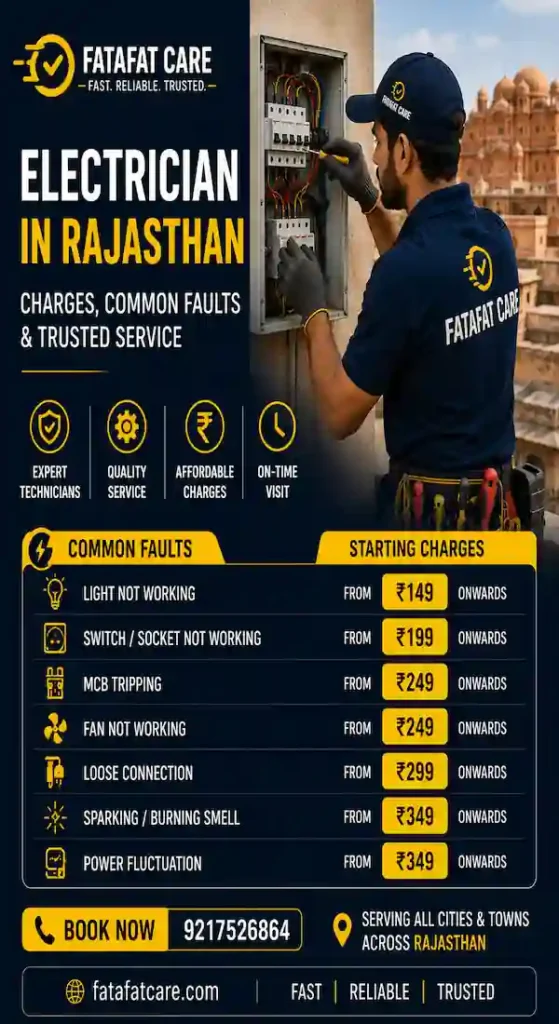
One of the most common complaints we hear from customers who’ve dealt with other electricians is not even about the quality of work — it’s about not knowing what they’d be charged until the job was done. Someone quoted ₹200 for a visit and ended up paying ₹1,800. This happens. We’ve heard it many times.
Here’s an honest guide to what electrical work typically costs in Rajasthan in 2026. These are market ranges — not what we charge specifically, but what you should expect to pay from any reasonably fair electrician in the region:
Visit and diagnosis charge: Rs. 150-300. This covers the technician coming, assessing the problem, and telling you what needs to be done. Should be communicated upfront before they visit.
Fan capacitor replacement (including part): Rs. 200-400. The capacitor itself is ₹80-150, labour is ₹100-200.
Fan motor rewinding: Rs. 600-900. Needed when the capacitor has been failing for a long time and the motor winding has been stressed.
Switchboard repair (tightening connections, replacing damaged sockets): Rs. 300-600.
Full switchboard replacement (new board, new sockets): Rs. 500-1,000 depending on size and number of points.
New 15A/20A AC point installation: Rs. 700-1,400 depending on distance from distribution board.
RCCB installation on one circuit: Rs. 400-700 including the RCCB unit.
Earthing repair or re-tightening: Rs. 300-600.
New earth pit installation: Rs. 1,200-2,500 depending on type (pipe earthing vs plate earthing) and soil conditions.
Full home wiring inspection: Rs. 600-1,200. Should include checking all visible wiring, all switchboards, earthing continuity, and load assessment. An electrician who does this in under 30 minutes hasn’t actually inspected anything.
At Fatafat Care, our electricians give you the cost before starting. If the job turns out to need more work than originally assessed, they discuss it with you before proceeding — not present you with a higher bill when the job is done.
What to Do Before Calling an Electrician
A few checks that can help you diagnose the rough problem and describe it better when you call:
Open your distribution board (the box with MCBs) and check whether any breaker is in the middle or off position. If one has tripped, note which one — “the one labelled AC” or “the second one from the left.” This tells you which circuit the problem is on.
Before calling about a whole-room power failure, check if your neighbours have power. If the street is dark, it’s a JVVNL or AVVNL supply fault — call the electricity board helpline, not an electrician. An electrician can’t fix a substation problem.
If an MCB is tripping repeatedly, don’t keep resetting it more than twice. Each reset on an active fault forces current through the fault point. Two resets is enough to confirm it’s not a random trip — after that, leave it off and call.
If you smell burning — from anywhere near your switchboard, from behind a wall, from any electrical fitting — do not wait. Turn off the main MCB at your distribution board and call immediately. A burning smell from an electrical fitting is a pre-fire condition.
Electrical Safety in Rajasthan Homes — The Things Worth Knowing
Bureau of Indian Standards IS 732 and IS 3043 specify standards for electrical wiring installations and earthing in residential buildings. The recommended inspection interval for residential electrical systems is every 5 years. I would estimate that fewer than 5% of Rajasthan homeowners have ever had a proper electrical inspection done. Most people only call an electrician when something stops working or starts sparking.
A few specific things that Rajasthan homeowners should know:
If your home was built before 2000, check whether it uses aluminium wiring. Many homes from that era were wired with aluminium instead of copper because aluminium was cheaper. Aluminium wiring is not inherently dangerous when properly installed and maintained, but it oxidises at connection joints faster than copper, and oxidised connections generate heat. If you have aluminium wiring, have the connection joints checked by an electrician every few years.
Load distribution matters. Rajasthan households today run significantly more electrical load than the same houses were designed for 20 years ago. Three or four ACs, multiple geysers, a washing machine, a water pump, an inverter — this is now normal. Many older distribution boards have only 4-6 circuits, which means multiple high-load appliances are sharing circuits they were never designed to handle simultaneously. A load audit — which any competent electrician can do in an hour — will tell you whether your current setup is safe or whether some circuits need to be split.
Outdoor wiring and terrace points need attention before monsoon season. Rajasthan gets less rain than most of India but the monsoon weeks we do get are intense. Outdoor points, terrace lighting, garden/courtyard wiring — all of this should be checked before July. Exposed connections in outdoor areas that have been fine through a dry Rajasthan winter can develop problems fast when humidity spikes during monsoon.
How We Find You the Right Electrician in Rajasthan
Fatafat Care currently has active electrician service across Jaipur and Dausa districts. In Jaipur we cover Mansarovar, Vaishali Nagar, Jagatpura, Pratap Nagar, Tonk Road, Sanganer, Jhotwara, Gopalpura, Bani Park, Shastri Nagar, Sodala, Raja Park, Murlipura, Vidhyadhar Nagar, Durgapura, Sitapura and surrounding areas. In Dausa we cover Dausa town, Bandikui, Lalsot, Sikrai, Mahwa, Bassi and Baswa.
We’re adding Alwar and Ajmer in the coming months. If you’re somewhere else in Rajasthan, call us at 9217526864 — if we have someone nearby we’ll send them. If we don’t, we’ll tell you honestly rather than send someone who isn’t the right fit for your area.
Every electrician in our network has been working in their local area for at least 2-3 years. They know local wiring practices, they know what common problems look like in their specific area, and they’re rated by customers after every job. The ones who get consistent good feedback get more bookings. The ones who don’t, get removed.
Before Monsoon — Get Your Home Electrically Ready
This is a section I’d have added to every blog if I could because it saves a lot of calls every year. Rajasthan’s pre-monsoon season — May through June — is the right time to get electrical work done before demand peaks in August-September when everyone discovers problems after the first rains.
Things worth checking before monsoon:
Outdoor points and terrace wiring — get any exposed or open connections sealed and weatherproofed. Outdoor switch boxes that aren’t properly sealed let in moisture during monsoon and corrode from the inside.
Earthing continuity — get it tested. The earth pit should be watered and topped up before monsoon to ensure good earth contact during the rainy period. This is a 30-minute job that makes a real difference.
Overhead water tank pump wiring — the pump motor connections near rooftop tanks are exposed to heat all summer and then suddenly to moisture in monsoon. Worth checking the connection condition and waterproofing before the rains hit.
Distribution board and main connections — check for any corrosion or discoloration at the main connection points. Pre-monsoon is a good time for a general tightening of all board connections, which takes maybe 20-30 minutes for a competent electrician.
Book an Electrician in Rajasthan
Call or WhatsApp us at 9217526864. Tell us your area and roughly what the problem is — even a vague description helps us send the right person. We confirm a technician and give you a time window before they visit. Price is discussed before work starts, not after.
For home repair services across Rajasthan including plumbing, AC repair, carpenter, RO service, and geyser repair — everything is available through the same number. Fatafat Care have the best Electrician in Rajasthan in its Technician Team.
Read more : For more guides on home repair across Rajasthan, read our complete guide to home repair services in Rajasthan and our detailed AC repair guide for Rajasthan. If you are in Dausa district, we have specific guides covering home repair services in Dausa, AC repair in Dausa and electrician service in Dausa — each written with local district context, hard water conditions and seasonal demand in mind.
Great content! Keep up the good work!