
RO Water Flow Slow? 6 Causes and How to Fix It
By Fatafat Care Technicians · Updated October 2026
You open the tap and wait. And wait. RO water flow slow enough to fill a glass in three minutes is one of the most common complaints we get — and in most cases, the fix is cheaper and simpler than people expect. This guide covers every cause, what you can check yourself, and when a technician actually needs to come in – if you need a technician now, visit Fatafat Care for same day service.
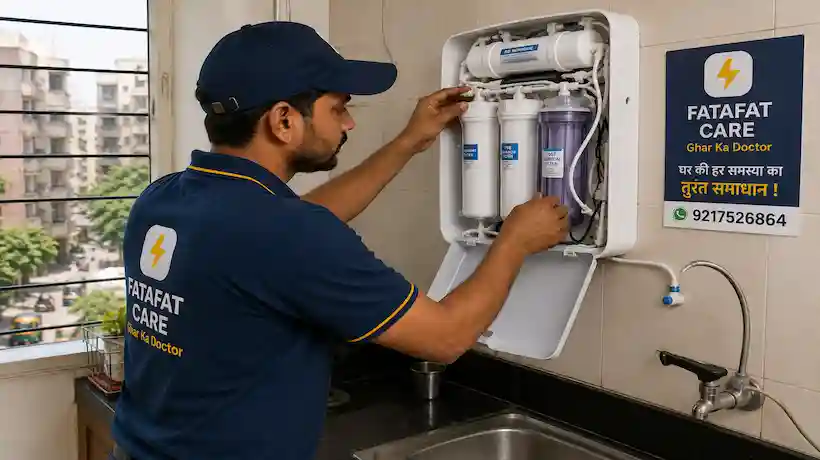
A normal RO purifier fills its storage tank in 1 to 2 hours and delivers water at a steady flow when you open the tap. When that becomes a trickle — or when filling a 1-litre bottle takes more than 3 to 4 minutes — something in the system is restricting flow. RO water flow slow is not always a serious problem. But left too long, a small restriction becomes a bigger one.
In Rajasthan and Gujarat — where borewell water with high TDS is the norm in many areas — RO filters choke faster than the service schedule suggests. Most technicians never mention this. On hard borewell water — Dausa, Kachchh, Gandhidham — a filter that should last 6 months chokes in 3. By the time the flow drops to a trickle, it has been half-blocked for weeks.
Here are all 6 causes of RO water flow slow, in order from most common to least.
6 Causes of RO Water Flow Slow — at a Glance
Every RO Water Flow Slow Cause — Explained in Detail
Clogged Sediment or Carbon Pre-Filter
Check YourselfThis is the number one RO water flow slow cause — and the cheapest to fix. The sediment filter is the first thing water hits when it enters the system. It catches sand, silt, rust, whatever the supply line is carrying. Block that and water can barely get through to anything else. The pump strains, the tank fills slower, and eventually you are waiting 10 minutes for a glass of water.
In areas with high TDS borewell water — which covers large parts of Rajasthan and Gujarat — this filter chokes much faster than in clean municipal supply areas. In Dausa, Kachchh, and parts of Ahmedabad running on groundwater, a sediment filter that is rated for 6 months may need replacing in 8 to 10 weeks during summer when supply water carries more sediment. Post-monsoon is the worst — rainwater flushes extra silt into the supply lines and the filter can clog in a matter of weeks.
What to do: Pull out the filter cartridge and hold it under a tap. If water barely flows through it, replace it — cleaning does not restore a fully clogged sediment filter. Replacement cartridges cost ₹50 to ₹150 and are available at any hardware or electronics shop. Changing this filter alone often restores full flow immediately. Check the carbon pre-filter at the same time — if the sediment filter was overdue, the carbon filter usually is too.
Going forward: in hard water areas, check the sediment filter every 6 to 8 weeks. Hold it up to light. Replace when it looks visibly dark. Do not wait for the flow to drop — by that point it has been half-blocked for weeks.
Low Inlet Water Pressure
Check YourselfRO is a pressure-driven process. The system needs at least 10 to 15 PSI of inlet pressure — some membranes need higher — to push water through the membrane effectively. Below that, the RO water flow slow problem appears even if every filter is clean and the membrane is new. The system just does not have enough pressure to work properly.
This is common in flats on upper floors where municipal supply pressure is low in the mornings, in areas with weak supply during summer afternoons, in homes running on a rooftop tank with low head pressure, and in areas where the building’s overhead tank is old and partially blocked. It also shows up after the supply pipeline outside gets repaired — the pressure sometimes does not come back fully.
What to do: If the inlet pressure is consistently low — not just a morning issue that improves later — the solution is a booster pump installed before the RO unit. This is a small pump that boosts inlet pressure to the level the RO needs. Cost: ₹800 to ₹2,000 for the pump plus installation. A technician fits it in under an hour. Once installed, this solves the RO water flow slow problem permanently on low-pressure supply lines.
If the pressure is good for most of the day but weak at specific times, try running the RO during high-pressure hours — early morning or late evening — until the supply situation improves.
Low Air Pressure in the Storage Tank
Check YourselfThis one surprises most people. The RO storage tank is not just a container — it has a rubber bladder inside with air pumped into it. When the tank fills with purified water, that water pushes against the bladder. The compressed air inside pushes back, and that pressure is what forces water out fast when you open the tap.
The air inside slowly leaks out over months — same as a tyre, just much slower. When it drops too low, there is nothing pushing the water out. The tank can be completely full and you still get a trickle at the tap. This is the one that gets missed most often because from the outside, everything looks completely fine.
What to do: Drain all water from the tank completely. Then use a bicycle pump or tyre gauge at the valve on the bottom of the tank (usually capped with a blue or black plastic cap). The tank should read 6 to 8 PSI when empty. If it reads lower — say 2 to 3 PSI — pump it up to 7 PSI. Refill and test. If the tank cannot hold pressure — you pump it up and it drops immediately — the bladder is ruptured and the tank needs replacement. A new storage tank costs ₹600 to ₹1,500 depending on the size and brand.
Choked or Fouled RO Membrane
TechnicianThe membrane is what actually purifies the water. It has pores so small they block dissolved salts, heavy metals, most contaminants. Over time those pores get coated — mineral scale, biological film, whatever slipped past the pre-filters. Once that builds up, water struggles to get through. Tank that used to fill in an hour now takes 4 to 6. Leave it long enough and the system barely produces anything.
In high TDS areas it happens faster. Groundwater in Kachchh and large parts of Rajasthan carries heavy calcium, magnesium, and dissolved minerals — and those coat the membrane surface fast. A membrane lasting 2 to 3 years on clean city water may need replacing in 12 to 18 months here. Not a defect in the purifier. Just what the membrane deals with every single day.
Some membranes can be chemically cleaned if caught early — a technician flushes a cleaning solution through the membrane housing to dissolve scale buildup. This can restore partial performance. If the membrane is severely fouled or more than 2 years old, replacement is the better call. Membrane replacement cost: ₹800 to ₹2,500 depending on the brand and GPD rating. The technician also checks the flow restrictor at this point — if the wrong size was installed previously, it gets replaced simultaneously.
Waterlogged Storage Tank (Ruptured Bladder)
TechnicianWhen the bladder inside the tank ruptures, water floods both sides — the air chamber and the water chamber mix. The tank can no longer build any pressure. You open the tap and get a brief flow — maybe half a glass — then it immediately drops to almost nothing. The tank feels heavy when you lift it, clearly full of water, but there is no air pressure left to push that water out. It just sits there.
A ruptured bladder cannot be repaired. The tank needs replacing. The good news is this is a straightforward job — a technician disconnects the old tank, connects the new one, and the system is back to full flow within an hour. Trying to keep using a waterlogged tank is pointless — the RO water flow slow problem will not improve, and the constant low pressure puts extra load on the pump.
Tank replacement runs ₹600 to ₹1,500 for the part plus ₹200 to ₹400 labour — total usually under ₹2,000. Standard tank in most home RO systems is 10 litres. Running out of water too fast? Get a 12 or 15-litre tank while you are at it.
Weak or Failing Booster Pump
TechnicianMost wall-mounted RO purifiers have a small booster pump inside. It keeps the pressure high enough to push water through the membrane. When it weakens — worn out, motor going, or damaged from running dry — pressure drops and the whole system slows down with it. The result is RO water flow slow across the board, regardless of filter condition or tank pressure. The system runs but barely produces water.
Pump failure is more common on purifiers over 4 to 5 years old, on units that have been run frequently on very high TDS water (which makes the pump work harder), and on units that have run dry due to a closed inlet valve being forgotten. Running dry for even a few minutes can damage the pump seals.
Pump replacement cost: ₹600 to ₹1,800 depending on the make and model. Labour is straightforward. On a purifier that is over 5 years old, it is worth checking the pump condition as part of the annual service — catching a weakening pump before it fails completely avoids the situation where the RO produces no water at all and the household is without purified water for a day or two waiting for the part.
What a Technician Checks on an RO Water Flow Slow Visit
When a Fatafat Care technician visits for an RO water flow slow complaint, here is the exact sequence:
Measured at the inlet valve. If below the minimum needed for the membrane, a booster pump is recommended before anything else is touched.
Pulled out and checked visually. Colour, condition, and service age noted. Replaced if due or if visibly blocked.
Tank drained, pressure checked at the Schrader valve. Should read 6 to 8 PSI empty. Pumped up if low, replaced if bladder is ruptured.
TDS meter used on input water and output water. If rejection rate has dropped significantly, membrane service or replacement is needed.
Pump output pressure measured. A weakening pump shows lower pressure than spec. Current draw checked with a meter to assess motor health.
All tubing checked for kinks or blockages. Flow restrictor checked for correct size — wrong size causes membrane fouling and slow production.
After this, you get a clear diagnosis and cost before any work starts. If the fix is just a filter change, that is all we charge for. We do not replace parts that do not need replacing.
RO Water Flow Slow — Repair Cost Reference 2026
Starting prices only. Exact cost depends on your purifier brand and model. We confirm the cost before starting work.
| RO Water Flow Slow Cause | Who Fixes It | Approx Cost |
|---|---|---|
| Clogged sediment filter — replace cartridge | Yourself | ₹50 – ₹150 (part only) |
| Low inlet pressure — identify and manage | Yourself | Free |
| Low tank air pressure — pump up bladder | Yourself | Free (bicycle pump) |
| Booster pump installation for low pressure | Technician | ₹800 – ₹2,000 |
| RO membrane cleaning or replacement | Technician | ₹800 – ₹2,500 |
| Storage tank replacement (ruptured bladder) | Technician | ₹800 – ₹2,000 |
| Booster pump repair or replacement | Technician | ₹600 – ₹1,800 |
| Full annual RO service (filters + check) | Technician | ₹400 – ₹800 |
RO Water Flow Still Slow After Checking the Basics?
Book a Fatafat Care RO technician. On-site diagnosis. Cost confirmed before work starts. No advance payment.
How to Prevent RO Water Flow Slow — What Actually Works
Most RO water flow slow problems are preventable. These are the habits that keep a purifier running properly for 6 to 8 years without major issues:
- Check the sediment filter every 6 to 8 weeks if you are on hard borewell water. Hold it up to light — replace when it looks dark. Do not wait for flow to drop.
- Annual service every year without fail. One service visit per year — technician changes filters, tests membrane, checks tank pressure, checks pump. This costs ₹400 to ₹800 and prevents most of the issues on this list.
- Never let the purifier run dry. If the inlet supply is cut off, close the inlet valve on the purifier. Running dry damages the pump seals and shortens pump life significantly.
- Check tank air pressure once a year. Drain the tank, check the valve with a bicycle pump. If it is below 6 PSI, pump it up. Takes 5 minutes and prevents slow flow from tank pressure loss.
- Get a booster pump if you are on a low-pressure supply. Upper floor flats, overhead tank supply, weak municipal pressure — a booster pump fitted once solves the RO water flow slow problem permanently in these situations.
- Do not ignore gradual slow-down. If your purifier that used to fill in 1 hour now takes 2, something is building up. Catching it at 2 hours is a filter change. Ignoring it until 5 hours may mean a membrane replacement.

Why People Book Fatafat Care for RO Service
Areas We Cover for RO Repair
We provide verified RO repair and home repair services across Rajasthan and Gujarat. Current active areas:
Rajasthan
Gujarat
Madhya Pradesh
Delhi
Book RO Repair — 60 Min Response
Whatever the RO water flow slow cause turns out to be — filter, membrane, tank, or pump — we diagnose it on-site before any work starts. No advance payment.
Frequently Asked Questions — RO Water Flow Slow
Start with the sediment filter — pull it out and hold it up to light. If it is dark, replace it. That alone fixes the RO water flow slow problem in about half the cases we see. If the filter looks clean, lift the storage tank. Heavy tank but trickle at the tap means low tank air pressure or a ruptured bladder. Light tank means the RO is not filling — which points to inlet pressure, membrane, or pump. This three-step check covers most RO water flow slow causes without needing any tools.
For most homes: sediment filter every 3 to 6 months, carbon filter every 6 to 12 months, RO membrane every 12 to 24 months. But these are averages for normal municipal water. If you are on high TDS borewell water — common in Dausa, Kachchh, and many parts of Rajasthan and Gujarat — all of these intervals get shorter. Check the sediment filter every 6 to 8 weeks visually. Replace when it looks dark. Do not wait for the RO water flow slow problem to appear before checking — by that point the filter has been restricting flow for weeks.
Heavy tank plus slow flow at the tap is almost always a tank pressure problem. The tank has water but not enough air pressure to push it out. Drain the tank completely, then check the air valve at the bottom with a bicycle pump or tyre gauge. It should read 6 to 8 PSI when empty. If it reads lower, pump it up. If water comes out of the air valve when you press it — the bladder inside has ruptured and the tank needs replacing. This is one of the most common RO water flow slow causes and it gets missed because the tank feels full and people assume the water is there, not realising the pressure to deliver it is gone.
Two signs: the tank fills much slower than before — taking 4 to 6 hours instead of 1 to 2 — and the TDS of your purified water has gone up noticeably. You can check TDS yourself with a cheap TDS meter (₹200 to ₹400 online). If your input water is 400 ppm and the output is now 150 ppm instead of the usual 30 to 50 ppm, the membrane is no longer rejecting properly. A technician can confirm this and also check whether a cleaning can extend membrane life or whether replacement is the better option based on the membrane’s age and condition.
Morning-only slow flow points to inlet pressure — not a fault inside the purifier. Municipal supply pressure in many Indian residential areas is lowest in the morning when everyone is using water simultaneously. The RO needs adequate inlet pressure to fill the tank. On low pressure, it fills slower and the tank depletes before it can refill. Open a regular tap in the kitchen at the same time and check whether that pressure is also weak. If yes, the issue is supply pressure — not the RO. A booster pump solves this permanently if the morning low pressure is a consistent problem in your building.
Three of the six RO water flow slow causes can be handled yourself without any tools: replacing the sediment filter (cartridge costs ₹50 to ₹150, takes 5 minutes), identifying low inlet pressure (check a regular tap to compare), and pumping up tank air pressure (bicycle pump, check the valve at the tank bottom). These three cover the majority of slow flow complaints. If you go through these and the RO water flow slow problem persists, membrane condition, pump health, and ruptured bladder all need a technician with the right tools to diagnose properly.