
Tap Leaking at Home? 5 Causes and How to Fix It
That drip at 2am doesn’t stop. You know it’s wasting water. You know it’s adding to your bill. But one tap dripping quietly loses 15 to 20 litres a day — and most homes have more than one. This guide covers what’s actually causing it, what you can fix yourself, and when you need a plumber.
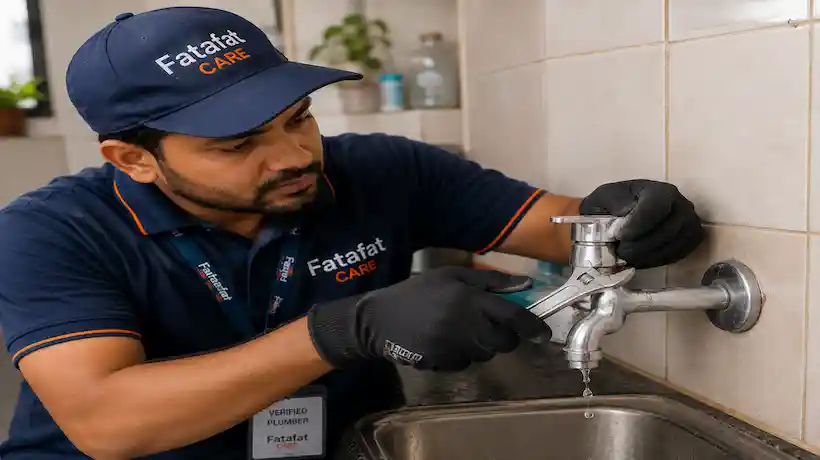
A tap leaking at home is the most common plumbing complaint we get — across Jaipur, Dausa, Gandhidham, Ahmedabad, and every area in between. Old homes, new flats, kitchen sinks, bathroom basins, the tap outside on the terrace — every one of them drips eventually.
The good news: most tap leaks come from one of five causes, and two of them are genuine DIY fixes if you have 20 minutes and a basic wrench. The other three need a plumber — but catching them early saves you from a simple ₹200 washer replacement becoming a ₹2,000 tap body replacement because the leak ran for months and damaged surrounding components.
Here is the complete breakdown — what is causing your tap leaking at home, where the leak is coming from, and what to do about it.
First — Where Is the Tap Leaking From?
Before checking causes, look at exactly where the water is coming from. This alone narrows down the problem immediately.
- Dripping from the spout when the tap is fully closed — worn washer or cartridge (Causes 1 and 2)
- Leaking from around the handle or neck — damaged O-ring or packing (Cause 3)
- Leaking from the base where the tap meets the sink — O-ring at the base or loose fitting (Cause 3)
- Leaking from under the sink or at the wall connection — pipe joint or valve issue (Cause 4)
- Multiple taps dripping across the house simultaneously — high water pressure (Cause 5)
Pinpoint the location first. Then read the relevant cause below.
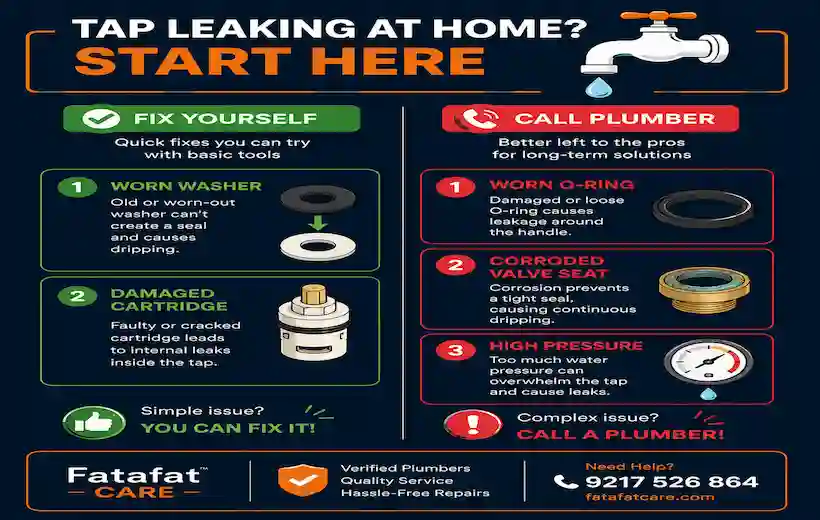
5 Causes of Tap Leaking at Home — at a Glance
Every Tap Leaking at Home Cause — Explained
Worn Rubber Washer
Fix YourselfThis is behind the majority of tap leaking at home complaints in India — especially in older homes with traditional pillar taps or bib taps. Every time you turn a tap on and off, the rubber washer inside presses against a metal seat to stop water flow. Do that ten times a day for five years and the washer hardens, cracks, or flattens. It cannot make a proper seal anymore. Water gets through. The drip starts.
In Rajasthan and Gujarat where water is hard — high calcium and magnesium content — washers deteriorate faster than in soft water areas. The minerals in the water harden the rubber over time, making it brittle. A washer that might last 5 to 7 years on clean soft water may need replacing in 2 to 3 years on borewell supply. We see this constantly in calls from older colonies in Jaipur, Dausa, and parts of Kachchh running on groundwater.
Fix it yourself: Close the isolation valve under the sink or the main supply valve for that tap. Turn the tap on to drain remaining water. Unscrew the tap handle — usually a screw under the decorative cap on top. Pull out the spindle. At the bottom of the spindle you will find the washer, held by a small nut. Replace it with the same size washer from any hardware shop — costs ₹5 to ₹20. Reassemble in reverse order. Open the supply. Test.
If the tap still drips after a fresh washer — the valve seat the washer presses against may be worn or corroded. That moves this from a washer job to Cause 4.
Damaged Cartridge in Mixer Taps
Fix YourselfMixer taps — the single-lever type in most modern kitchens and bathrooms — work nothing like a traditional pillar tap. No rubber washer, no spindle. Inside sits a ceramic or plastic cartridge. Two ceramic discs rotate against each other to control the flow. When those discs wear, chip, or catch a piece of grit between them, that’s when the dripping starts.
Cartridge failure is more common in homes with hard water — the calcium deposits that form on the ceramic discs over time prevent a clean seal. It also happens in mixer taps that are overtightened repeatedly — people assume turning the lever harder will stop a drip, but that actually chips the ceramic disc faster.
Fix it yourself: Close the water supply. Remove the lever handle — usually one Allen key screw underneath or behind the handle. Remove the cartridge retaining nut. Pull out the old cartridge. Take it to a plumbing or hardware shop and match the size exactly — cartridges are not universal and each brand has specific sizes. Jaquar, Hindware, Parryware, and Kohler all use different cartridges. Fit the new one, reassemble, and test.
If you cannot find a matching cartridge locally or are not comfortable dismantling the mixer body, a plumber can do this in 30 minutes. Total cost with cartridge and labour: ₹400 to ₹1,200 depending on brand.
Worn O-Ring or Packing Around the Spindle
PlumberThe O-ring is a small rubber ring that seals the spindle — the rotating part of the tap — where it passes through the tap body. When it wears out, water escapes around the spindle and drips from the handle area or from the neck of the tap rather than the spout. This tap leaking at home pattern is easy to spot — water pools around the base of the handle, not from the tip of the tap.
Some taps use a packing material — waxed thread or graphite rope — around the spindle instead of an O-ring. Same principle, different material. Both wear out over time, especially in hard water areas where mineral deposits work their way into the gap and degrade the seal from inside.
This repair requires removing the tap body and accessing the spindle — which in older taps with corroded threads can go wrong quickly without experience. Over-tighten the packing nut and you can crack the tap body — a common mistake when people try to stop a drip by forcing it tighter. A plumber fixes this in 20 to 30 minutes. O-ring replacement including labour runs ₹200 to ₹600. If the tap body itself is corroded or cracked near the spindle, replacing the whole tap is the smarter call.
Corroded Valve Seat or Loose Pipe Joint
PlumberThe valve seat is the metal surface inside the tap body that the washer presses against to stop water. Over years, mineral deposits build up on this seat and create a rough, uneven surface. Even a brand new washer cannot seal properly against a corroded seat — so the tap leaking at home problem comes back within days or weeks of replacing the washer. This is why “I just changed the washer but it is still dripping” is one of the most common things customers tell us.
A loose pipe joint is a different but related issue — the connection between the tap and the supply pipe has worked loose over time, or the plumber’s tape used during installation has degraded. Water seeps from the joint, often appearing under the sink rather than from the tap itself. In older buildings in Jaipur and across Rajasthan where pipes were fitted 10 to 20 years ago without proper threading compounds, this is common.
How to tell — loose joint: Water appears under the sink or at the wall connection point, not from the tap itself. Damp patch on the wall behind the tap that was not there before. Rust staining on the pipe threads visible when you look under the sink.
A corroded valve seat needs a seat grinding tool to resurface it — something most homeowners don’t own but every plumber carries. Ten minutes with the right tool. Cost: ₹300 to ₹600.A loose joint means turning off the supply, opening the joint, stripping the old tape, wrapping fresh PTFE on the threads and tightening to the right torque. Too tight and the threads strip. Cost: ₹200 to ₹500.Both jobs — faster and safer with a plumber.
High Water Pressure
PlumberThis is the tap leaking at home cause that affects multiple taps at once and stumps people because changing the washer on one tap does not fix the problem — the drip just comes back, or another tap starts. High water pressure forces water past seals that would hold fine under normal pressure. It also accelerates wear on washers and O-rings significantly.
Normal residential water pressure in India should be between 1 to 3 bar (15 to 45 PSI). When pressure exceeds 4 to 5 bar — which happens in ground-floor flats where the building’s overhead tank is full and creates high head pressure, or in areas where the municipal supply is at high pressure — taps drip even when fully closed, pipes make banging sounds, and shower heads spray erratically.
The fix is a pressure reducing valve (PRV) installed on the main supply line entering the home. A plumber measures the incoming pressure with a gauge and installs a PRV set to 2 to 2.5 bar. This one fix stops multiple taps leaking at home simultaneously, extends the life of all washers and cartridges in the house, and also protects geysers and washing machines from pressure-related damage. PRV cost: ₹800 to ₹2,500. Labour: ₹500 to ₹800.
How to Fix a Dripping Tap Yourself — Step by Step
This is for traditional pillar taps with a rubber washer. Mixer taps follow a similar sequence but with a cartridge instead. Switch off the water supply before starting — always.
Turn the isolation valve under the sink clockwise until fully closed. No isolation valve? Close the main stopcock for that section. Open the tap to drain remaining water from the pipe.
Pop off the decorative cap on top of the handle — it usually pries off with a flat screwdriver. Underneath is a screw. Remove it and lift the handle off.
Use an adjustable wrench to unscrew the packing nut — the hexagonal nut under the handle. Wrap the nut in cloth before using the wrench to avoid scratch marks on chrome taps.
The spindle pulls straight out once the packing nut is removed. At the bottom you will see the washer — a flat rubber disc held by a small brass nut.
Unscrew the brass nut, remove the old washer, fit the new one of the same size. Match it exactly — too large and it bulges, too small and it will not seal. Hardware shops have sets of common sizes for ₹20 to ₹50.
Put the spindle back, tighten the packing nut snugly — not as tight as possible, just firm. Refit the handle and screw. Open the supply slowly. Check for drips from the spout and from around the handle for 2 minutes.
Tap Leaking at Home — Repair Cost Reference 2026
Starting prices. Final cost depends on tap brand, age, and what needs replacing. Cost confirmed before work starts.
| Tap Leaking at Home Cause | Who Fixes It | Approx Cost |
|---|---|---|
| Worn washer — replacement | Yourself | ₹5 – ₹20 (part only) |
| Cartridge replacement — mixer tap | Yourself | ₹150 – ₹800 (part only) |
| Washer + labour (plumber visit) | Plumber | ₹150 – ₹400 |
| O-ring or packing replacement | Plumber | ₹200 – ₹600 |
| Cartridge replacement with labour | Plumber | ₹400 – ₹1,200 |
| Valve seat resurfacing | Plumber | ₹300 – ₹600 |
| Pipe joint repair (loose fitting) | Plumber | ₹200 – ₹500 |
| Full tap replacement | Plumber | ₹500 – ₹3,000 (tap + labour) |
| Pressure reducing valve installation | Plumber | ₹1,300 – ₹3,300 |
Tap Still Leaking After Checking the Basics?
Book a Fatafat Care plumber. On-site diagnosis. Cost confirmed before work starts. No advance payment.
How to Prevent Tap Leaking at Home — Simple Habits
- Never overtighten a closed tap. One firm turn to close is enough. Forcing it harder does not stop the drip — it destroys the washer faster and eventually cracks the seat. This is the single biggest cause of early washer failure we see.
- Fix a drip the moment you notice it. A tap leaking at home does not fix itself. The dripping water wears the seat further, hardens the washer, and eventually corrodes the tap body. A ₹20 washer job left for 6 months becomes a ₹1,500 tap replacement.
- In hard water areas — change washers proactively every 2 to 3 years. Jaipur, Dausa, Gandhidham, and most of Rajasthan and Gujarat have hard water. Rubber washers do not last as long here. A plumber replacing all washers in one visit costs less than one emergency call for a burst fitting.
- Use quality taps. We’ve seen it enough times to say it plainly — buy a cheap tap and you’ll be calling a plumber within 18 months. Jaquar, Kohler, Parryware, Hindware — any of these runs 8 to 12 years with normal use. The saving on the tap isn’t worth the repair calls.
- Check under sinks once a year. Open the cabinet under the kitchen and bathroom sinks. Look for any damp patches, rust staining, or white mineral deposits on joints. These are early signs of a slow leak that has not become visible yet. Catching it now costs ₹200. Ignoring it until the cabinet floor is rotted costs ₹5,000.
Why People Book Fatafat Care for Plumber Work
Areas We Cover for Plumber Services
Verified plumber services across Rajasthan, Gujarat and Madhya Pradesh. Current active areas:
Rajasthan — Key Districts
Jaipur Areas
Gujarat — Key Districts
Kachchh Areas
Madhya Pradesh
Book a Plumber — 60 Min Response
Whatever the tap leaking at home cause — washer, cartridge, O-ring, valve seat, or pressure — we diagnose it on-site before any work starts. No advance payment.
Frequently Asked Questions — Tap Leaking at Home
A tap leaking at home from the spout with the handle fully closed almost always means the rubber washer inside has worn out and cannot seal properly. In mixer taps it is usually the ceramic cartridge. Both wear from regular use — the washer gets compressed every time you close the tap and eventually loses its shape. In hard water areas like most of Rajasthan and Gujarat, mineral deposits harden the rubber faster. A new washer costs ₹5 to ₹20 and fixes the drip in 20 minutes if the valve seat underneath is still smooth. If the drip returns quickly after a new washer, the seat is corroded and needs a plumber to resurface it.
A slow drip — one drop per second — wastes roughly 15 to 20 litres per day. That is 450 to 600 litres a month from one tap. A faster drip, the kind that forms a thin stream rather than individual drops, wastes 3 to 4 times that. At Jaipur’s municipal water rates, a leaking tap adds ₹50 to ₹200 per month to the water bill depending on speed. Beyond the bill, tap leaking at home problems cause rust staining in basins and sinks, mould growth in cabinet spaces under sinks, and in serious cases water seeping into walls and flooring. Fix it early — the repair cost is always less than the damage cost.
Water coming from around the handle or neck of the tap — not the spout — means the O-ring or packing around the spindle has worn out. The spindle is the rotating part inside the tap that opens and closes water flow. The O-ring seals the gap between the spindle and the tap body. When it fails, water escapes upward around the spindle and drips from the handle area. This is a plumber job — it requires removing the tap body components and replacing the O-ring without overtightening the packing nut, which can crack older brass taps. Cost: ₹200 to ₹600 with labour.
If the tap leaking at home problem returns immediately or within a few days of a new washer, the valve seat — the metal surface the washer presses against — is corroded or damaged. A new washer cannot seal against a rough or pitted seat regardless of quality. The solution is valve seat resurfacing, which a plumber does with a special grinding tool in 10 minutes. It smoothens the seat so any new washer can seal properly. If the seat is too far gone to resurface, the tap needs replacing. This is why a drip that has been ignored for months ends up costing more than one caught early.
Multiple taps leaking at home at the same time almost always points to high water pressure — not individual tap faults. When supply pressure is too high, it forces water past washers and cartridges that would seal fine under normal pressure. The fix is a pressure reducing valve installed on the main supply line. A plumber measures incoming pressure with a gauge and installs the PRV set to 2 to 2.5 bar. This one fix stops all the drips, extends the life of every washer and cartridge in the house, and also protects geysers and washing machines from pressure damage. Cost: ₹1,300 to ₹3,300 including the valve and labour.
Replace the whole tap when: the tap body has visible cracks or corrosion on the outside, the spindle threads have stripped so the handle spins without closing water, the valve seat cannot be resurfaced because it is too corroded, the tap is more than 10 years old and repairs keep coming back within weeks, or the repair cost for a premium tap cartridge exceeds 50% of a new tap’s price. A good quality replacement tap from Jaquar or Parryware costs ₹800 to ₹3,000 depending on type, plus ₹300 to ₹500 for a plumber to fit it. That is a one-time fix rather than repeated service calls on a failing old tap.