
Geyser Not Heating Water? 6 Causes and How to Fix It
Cold water on a winter morning when you switched the geyser on 30 minutes ago. The light is on, nothing looks broken, but the geyser not heating water problem is real. We get these calls every October when people switch their geysers back on after months and find something has quietly gone wrong. Here is exactly what to check and what each cause means.
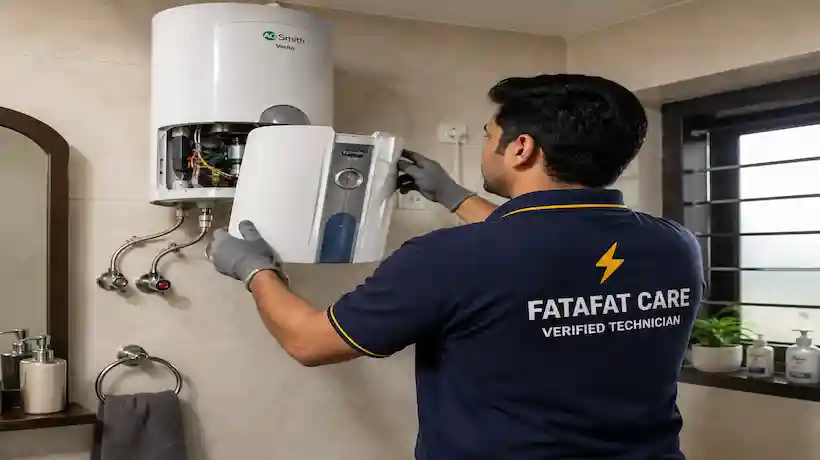
A geyser not heating water is one of the most searched problems every winter in India. In Rajasthan and Gujarat — where temperatures drop sharply from October onward and geysers sit unused through the summer months — we see a surge of these calls from late September. The unit ran fine last February. Six months later, same geyser, same setup, no hot water.
Most geyser not heating water problems have clear causes. Two of them you can check yourself in under 5 minutes without touching the geyser internally. The other four need a technician — but knowing which one applies saves you an unnecessary service charge and helps you describe the problem accurately when you call.
Read through from the top. The causes are arranged from the simplest check to the more serious internal faults.
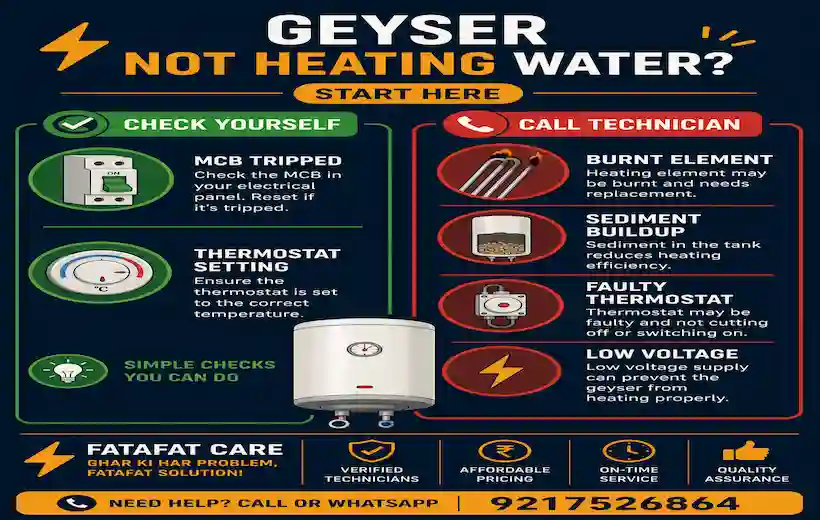
6 Geyser Not Heating Water Causes — Quick Overview
Every Geyser Not Heating Water Cause — Explained
MCB Tripped or Power Fault
Check YourselfStart here — always. The geyser not heating water problem is sometimes not a geyser problem at all. The MCB on your geyser’s dedicated circuit may have tripped, cutting power completely. The geyser indicator light may still glow on some models even when the MCB is off — which is why this gets missed. The unit looks like it is on but the element is getting no power.
Geysers draw 2,000 watts or more. When switched on after months of sitting idle, the initial surge can trip an older or undersized MCB. In older homes across Jaipur’s established colonies and Kachchh’s residential areas, geyser circuits sometimes share MCBs with other heavy loads — which makes tripping on first use after summer even more likely.
If the MCB holds and the geyser light comes on but there is still no heating after 15 to 20 minutes, the power supply is fine and the fault is internal. Move to Cause 3.
Wrong Thermostat Setting or ECO Switch Tripped
Check YourselfEvery storage geyser has a thermostat dial — usually behind a small cover panel on the front or side of the unit. This dial controls what temperature the geyser heats to. If someone turned it down to minimum — or if it shifted over months of sitting unused — the geyser heats water to only 30°C or 35°C. Feels cold. Geyser not heating water problem — but actually a setting issue.
There is also a small reset button on most geysers called the ECO switch or thermal cutout. It trips when the water gets too hot — cuts power to the element and stays cut until you press it manually. Left the geyser on all night? That can trigger it. Faulty thermostat that let the water boil? Same result.
If the ECO switch keeps tripping after you reset it, the thermostat is likely faulty and the geyser is overheating repeatedly — which then trips the cutout as a safety measure. That moves this from a DIY fix to Cause 5.
Burnt or Failed Heating Element
TechnicianThe heating element is what physically heats the water inside the tank. It is a coil submerged in water — electricity passes through it, it heats up, water heats around it. When an element burns out, the geyser runs, the light is on, power is reaching the unit — but no heat is produced. The geyser not heating water problem with a burnt element is often sudden and complete. One day fine, next day nothing.
Hard water accelerates element failure significantly. Water in many parts of Rajasthan and Gujarat carries high levels of dissolved calcium and magnesium. These minerals coat the element in a white chalky layer called limescale. Limescale acts as insulation — the element has to work harder to heat through it, runs hotter than designed, and eventually burns out. An element that should last 5 to 7 years on clean municipal water may fail in 2 to 3 years on hard borewell water. We see this regularly in calls from Dausa, Bandikui, Gandhidham, and Bhuj.
Element replacement is one of the more common geyser repairs — and not expensive if done before the failed element causes tank corrosion. The part costs ₹300 to ₹800 depending on brand and wattage. Labour is ₹300 to ₹500. Total cost usually ₹600 to ₹1,300. If the element has been burnt for a while, the technician will also check the anode rod and tank lining for secondary damage.
Heavy Sediment and Scale Buildup
TechnicianNobody notices this one until it is too late. Hard water minerals — calcium, magnesium — slowly build up inside the tank over months. They coat the element in a thick layer. The geyser still heats, technically. But slower every season, never as hot as before, running more and more just to keep up.
By the time a customer calls us, the usual description is: the geyser used to give hot water in 15 minutes, now it takes 45. Or the water is warm but never properly hot. That gradual worsening over a season is almost always sediment. In hard water areas — which covers most of rural Rajasthan and large parts of Gujarat — this builds up faster. The recommended service interval is every 12 months for hard water areas, every 18 to 24 months for cleaner municipal supply.
A technician drains the tank, flushes out the sediment, descales the element, and checks the anode rod. The anode rod is a sacrificial metal rod inside the tank designed to corrode instead of the tank lining. When it is fully corroded, the tank itself starts to rust from inside — which is expensive. Replacing the anode rod during a service costs ₹300 to ₹700 and extends tank life by years. Full descaling and service cost: ₹500 to ₹1,200.
Faulty Thermostat
TechnicianThe thermostat has two jobs: tell the element to start heating when water temperature drops below the set level, and tell it to stop when the target is reached. When the thermostat fails, it can do one of two wrong things — it either never signals the element to start (geyser not heating water at all), or it never signals it to stop (water overheats and the ECO switch trips as described in Cause 2).
A thermostat that permanently fails to signal heating is the more common version. The element is fine, power is fine, but the thermostat reads the water as already hot even when it is stone cold. The geyser does nothing. From outside, the geyser looks like it is working. The indicator may be on. But no heat is produced because the thermostat has decided — incorrectly — that no heating is needed.
Thermostat replacement is a clean straightforward job. The part costs ₹200 to ₹600. A technician replaces it in 30 to 45 minutes. On geysers over 7 to 8 years old with a known thermostat fault, it is worth asking the technician to check the element at the same time — both components wear at similar rates and replacing one while the other is borderline saves a second call-out within months.
Low Voltage Supply
TechnicianA geyser heating element needs sufficient voltage to heat effectively. Most elements are designed for 220V to 240V. When supply voltage drops consistently below 180V to 190V — which happens in many residential areas during peak winter mornings when grid demand is highest — the element heats so slowly it barely warms the water in 30 to 40 minutes. The geyser not heating water problem here is real but subtle. Water is lukewarm at best, never properly hot.
Older residential areas on Jaipur’s outskirts, semi-urban localities across Rajasthan and Gujarat — these are the places where this hits hardest. In winter, every household runs geysers, heaters, and blankets simultaneously. The grid cannot keep up. Voltage at the household level quietly drops and the geyser pays the price.
A voltage stabiliser rated 5 KVA protects the geyser from both undervoltage and overvoltage. Cost: ₹1,500 to ₹3,500. If the issue is also affecting other appliances and the entire home is seeing low voltage, the problem may be in the building’s wiring or the external supply — an electrician needs to assess the incoming voltage and the geyser’s dedicated circuit separately.
What Our Technician Checks on a Geyser Not Heating Water Visit
When a Fatafat Care technician arrives for a geyser not heating water complaint, this is the exact sequence followed:
Voltage at the socket measured first. MCB condition checked. A geyser not heating water due to supply issues is ruled out before the unit is opened.
Cover panel opened. Thermostat dial position checked. ECO switch condition checked — tripped or normal. Reset if tripped, tested again.
Element resistance measured. A working element shows 10 to 30 ohms depending on wattage. Open circuit = burnt element. Short circuit = replace immediately.
Thermostat tested for correct switching — does it signal the element at the right temperature? A faulty thermostat is confirmed here if element tested fine.
Tank drained partially to check sediment level, water colour, and anode rod condition. A corroded rod is flagged for replacement to protect the tank lining.
After diagnosis, exact cost is confirmed with you before any part is replaced. No work starts without your approval. No advance payment taken.
Geyser Not Heating Water — Repair Cost Reference 2026
Starting prices only. Final cost depends on your geyser brand, model, age, and what parts are needed. Cost confirmed before work starts.
| Geyser Not Heating Water Cause | Who Fixes It | Approx Cost |
|---|---|---|
| MCB tripped — reset | Yourself | Free |
| Thermostat setting / ECO switch reset | Yourself | Free |
| Heating element replacement | Technician | ₹600 – ₹1,300 |
| Descaling and sediment flush | Technician | ₹500 – ₹1,200 |
| Thermostat replacement | Technician | ₹400 – ₹900 |
| Anode rod replacement | Technician | ₹300 – ₹700 |
| Voltage stabiliser installation | Technician | ₹1,500 – ₹3,500 |
| Full annual geyser service | Technician | ₹400 – ₹800 |
Geyser Not Heating Water? Book a Technician Now
Verified Fatafat Care technician. Diagnosis done on-site. Cost confirmed before work starts. No advance payment.
How to Prevent Geyser Not Heating Water Problems
Most geyser not heating water problems that appear in October could have been caught in March. Here is the simple annual routine:
- Annual service — March or April, before you switch it off for summer. A technician drains the tank, checks the element and thermostat, replaces the anode rod if needed, and clears sediment. One service prevents 70 to 80% of the autumn geyser not heating water complaints we receive. Cost: ₹400 to ₹800.
- Do not leave the geyser on 24 hours. Switch it on 20 to 30 minutes before you need hot water. Continuous operation at full heat accelerates element burnout and scale formation on the heating element.
- Set thermostat to 55°C to 60°C — not higher. Higher temperatures cook the element faster and cause calcium to precipitate onto it more aggressively. 55°C is enough for comfortable bathing and kills bacteria safely.
- Check the anode rod every 3 years. In hard water areas — Dausa, Kachchh, most of rural Rajasthan — every 2 years. A ₹400 rod replacement prevents a ₹4,000 tank replacement.
- When switching the geyser back on after summer: Fill the tank with water fully before switching power on. Switching on an empty geyser burns the element within minutes — this is called dry firing and destroys the element completely.
- Check the MCB rating. A geyser needs a 20A MCB on its own dedicated circuit. If it shares a circuit, the MCB keeps tripping issue will follow every winter. An electrician can add a dedicated circuit in under an hour.
Why People Book Fatafat Care for Geyser Repair
Areas We Cover for Geyser Repair
Verified geyser repair across Rajasthan and Gujarat. Current active areas:
Jaipur, Rajasthan
Rajasthan Districts
Kachchh District, Gujarat
Ahmedabad, Gujarat
Surat, Gujarat
Book Geyser Repair — 60 Min Response
Whatever the geyser not heating water cause — element, thermostat, sediment, or voltage — we diagnose it on-site before any work starts. No advance payment.
Frequently Asked Questions — Geyser Not Heating Water
The indicator light runs on separate power — it stays on even when the heating element has failed. Water cold but light on means three things: MCB tripped at the distribution board, ECO thermal cutout tripped (press reset button behind front panel), or burnt element. Check first two yourself. Still cold — call a technician.
A 15-litre storage geyser with a 2,000-watt element typically heats a full tank from cold to 60°C in 20 to 35 minutes. A 25-litre tank takes 40 to 55 minutes. If your geyser is taking significantly longer than these times — say 60 to 90 minutes for a 15-litre unit — the element is likely scaled or partially burnt, or the voltage supply is consistently low. This is one of the early signs of geyser not heating water problems that most people miss because heating eventually happens, just slower.
A geyser MCB tripping repeatedly points to one of three causes: the element has developed an earth leakage fault (current escaping to the tank body), the thermostat is defective and letting the water overheat which draws excessive current, or the MCB is undersized for the geyser’s load — a 2,000-watt geyser needs a 16A MCB minimum on a dedicated circuit. If the MCB trips the instant the geyser is switched on, the fault is almost certainly the element — it has shorted internally and is causing an immediate overload. Switch off and call a technician. Do not keep resetting a geyser MCB that trips on every attempt.
The element check requires a multimeter and working inside the geyser with the power switched off at the MCB. It is not a dangerous DIY task for someone comfortable with basic electrical work — switch off the MCB, confirm no power with a tester, drain some water, remove the element cover, disconnect the element wires, and measure resistance across the terminals. 10 to 30 ohms means the element is working. Open circuit (infinite) means burnt. However, if you are not comfortable around electrical wiring, leave this to a technician — the risk of getting it wrong is a shock or a flooded bathroom, not just a wrong diagnosis.
In hard water areas — which covers most of Rajasthan and large parts of Gujarat — service every 12 months. In normal municipal supply areas, every 18 to 24 months is sufficient. The annual service includes descaling the element, flushing sediment from the tank, checking the anode rod, and testing the thermostat and ECO switch. Skipping this for 2 to 3 years in hard water areas almost guarantees a geyser not heating water problem within that period — usually from a burnt element or a completely corroded anode rod leading to tank rust.
Lukewarm but never hot is a different problem from no heating at all. This geyser not heating water variant usually means one of three things: thermostat set too low (check the dial — it may be at position 2 or 3, push to 5), heavy scale on the element reducing heat transfer efficiency, or consistent low voltage during peak morning hours. Start with the thermostat dial — it takes 30 seconds and fixes this in a surprising number of calls. If the dial is set correctly and the problem persists, a technician should check element condition and incoming voltage.